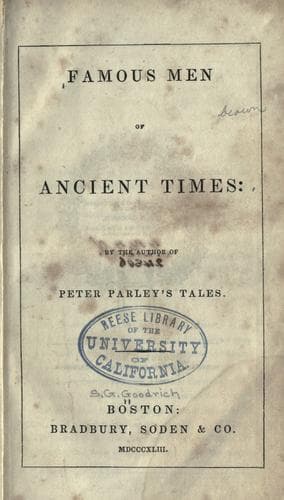
Famous Men of Ancient TimesGoodrich, Samuel G. (Samuel Griswold)
History
Famous Men of Ancient Times
Goodrich, Samuel G. (Samuel Griswold)
Biography -- Juvenile literature; Men -- Biography -- Juvenile literature
In his will he had ordered that the Æneid should be burnt, not having
finished it to his mind; but Augustus wisely forbade the destruction of
a performance which will perpetuate his name, as one of the greatest
of poets. It was, therefore, delivered to Varius and Tucca, Virgil’s
intimate friends, with the strictest charge to make no additions, but
merely to publish it correctly, in the state it then was.
In person, Virgil was tall, and wide-shouldered, of a dark swarthy
complexion, which probably proceeded from the southern extraction
of his father; his constitution was delicate, and the most trifling
fatigue, either from exercise or study, produced violent headache and
spitting of blood. In temper he was melancholy and thoughtful, loving
retirement and contemplation. Though one of the greatest geniuses
of his age, and the admiration of the Romans, he always preserved
a singular modesty, and lived chastely when the manners of the
people were extremely corrupt. His character was so benevolent and
inoffensive, that most of his cotemporary poets, though they envied
each other, agreed in loving and esteeming him. He was bashful to a
degree of timidity; his aspect and behavior was rustic and ungraceful;
yet he was so honored by his countrymen, that once, coming into the
theatre, the whole audience rose out of respect to him. His fortune was
large, supposed to be about seventy thousand pounds sterling, besides
which he possessed a noble mansion, and well-furnished library on the
Esquiline Mount, at Rome, and an elegant villa in Sicily. Both these
last, he left to Mecænas, at his death, together with a considerable
proportion of his personal property; the remainder he divided between
his relations and Augustus,—the latter having introduced a politic
fashion of being in everybody’s will, which alone produced a sufficient
revenue for a prince.
The works of Virgil are not only valuable for their poetic beauties,
but for their historical allusions and illustrations. We here find a
more perfect and satisfactory account of the religious customs and
ceremonies of the Romans, than in any other of the Latin poets, Ovid
excepted. Everything he mentions is founded upon historical truth.
He was uncommonly severe in revising his poetry—and often compared
himself to a bear that licks her cubs into shape.
In his intercourse with society, Virgil was remarkable; his friends
enjoyed his unbounded confidence, and his library and possessions in
Rome were so liberally offered for the use of those who needed them,
as to seem to belong to the public. Amiable and exemplary, however, as
he was, he had bitter enemies; but their revilings only served to add
lustre to his name and fame.
[Illustration]
Public-domain text, read in full here on John Shaqi.
Reviews
Reviews
No reviews yet
Be the first to share your thoughts on this work.
Join the Discussion
Join the discussion
Sign in to leave a comment or review.
Sign InorCreate an account