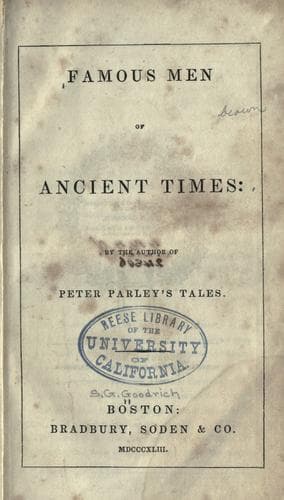
Famous Men of Ancient TimesGoodrich, Samuel G. (Samuel Griswold)
History
Famous Men of Ancient Times
Goodrich, Samuel G. (Samuel Griswold)
Biography -- Juvenile literature; Men -- Biography -- Juvenile literature
At Medina, whither his tenets had been carried by pilgrims, Mohammed
was received with open arms. He was met by an imposing procession,
and invested at once with the regal and sacerdotal office. The people
also offered him assistance in propagating his faith, even by force,
if it should be required. From this moment, a vast field seems to have
been opened to the mind of Mohammed. Hitherto, he may have been but a
self-deceived enthusiast; but now, ambition appears to have taken at
least partial possession of his bosom. His revelations at once assumed
a higher tone. Hitherto he had chiefly inculcated the doctrine of one
God, eternal, omnipotent, most powerful and most merciful, together
with the practical duties of piety, prayer, charity, and pilgrimages.
He now revealed, as a part of his new faith, the duty of making war,
even with the sword, to propagate Islamism, and promised a sensual
paradise to those who should fall in doing battle in its behalf. At the
same time he announced that a settled fate or destiny hung over every
individual, which he could not by possibility alter, evade, or avert.
He now raised men, and proceeded, sword in hand, to force the
acknowledgment of his pretensions. With alternate victory and defeat,
he continued to prosecute his schemes, and at last fell upon the towns
and castles of the peaceful and unwarlike Jews. These were soon taken
and plundered. But the prophet paid dearly for his triumph. A Jewish
female, at the town of Chaibar, gave him poison in some drink, and,
though he survived, he never fully recovered from the effects of the
dose.
Thus advancing with the tribes settled in his own country, the power of
the ambitious apostle increased like the avalanche in its overwhelming
descent. Mecca was conquered, and yielded as well to his faith as
to his arms. He now made expeditions to Palestine and Syria, while
his officers were making conquests in all directions. His power was
soon so great, that he sent messages to the kings of Egypt, Persia,
and Ethiopia, and the emperor of Constantinople, commanding them to
acknowledge the divine law revealed through him.
At last, in the tenth year of the Hegira, he proceeded on a farewell
pilgrimage to Mecca. The scene was imposing beyond description. He was
attended by more than a hundred thousand of his followers, who paid
him the greatest reverence. Everything in dress, equipage and imposing
ceremony that could enhance the splendor of the pageant, and give it
sanctity in the eyes of the people, was adopted. This was the last
great event of his life.
Public-domain text, read in full here on John Shaqi.
Reviews
Reviews
No reviews yet
Be the first to share your thoughts on this work.
Join the Discussion
Join the discussion
Sign in to leave a comment or review.
Sign InorCreate an account