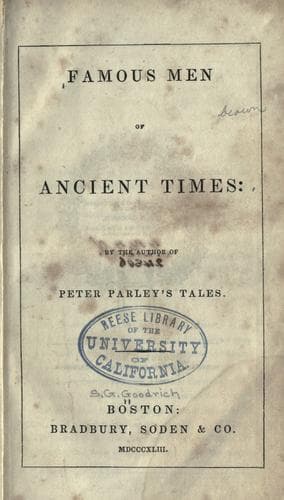
Famous Men of Ancient TimesGoodrich, Samuel G. (Samuel Griswold)
History
Famous Men of Ancient Times
Goodrich, Samuel G. (Samuel Griswold)
Biography -- Juvenile literature; Men -- Biography -- Juvenile literature
The army of Caled returned victorious. Moseilama himself, and ten
thousand of his followers, were left dead on the field; while the rest,
convinced by the shining evidence of truth that gleamed from the swords
of the conquerors, renounced their errors, and fell quietly back into
the bosom of the Mohammedan church. Several other insurgents of similar
pretences, but of minor consequence, were crushed in like manner in the
early stages of their defection.
We have now reached the period at which the religion of Mohammed may
be considered as having become permanently established. The conquest
of Mecca and of the Koreishites had been, in fact, the signal for the
submission of the rest of Arabia; and though several of the petty
tribes offered, for a time, the show of resistance to the prophet’s
arms, they were all eventually subdued. Between the taking of Mecca
and the period of Mohammed’s death, somewhat more than three years
elapsed. In that short period he had destroyed the idols of Arabia; had
extended his conquests to the borders of the Greek and Persian empires;
had rendered his name formidable to those once mighty kingdoms; had
tried his arms against the disciplined troops of the former, and
defeated them in a desperate encounter at Muta.
His throne was now firmly established; and an impulse given to the
Arabian nation, which induced them to invade, and enabled them to
conquer, a large portion of the globe. India, Persia, the Greek empire,
the whole of Asia Minor, Egypt, Barbary, and Spain, were eventually
reduced by their victorious arms. Mohammed himself did not indeed live
to see such mighty conquests achieved, but he commenced the train
which resulted in this wide-spread dominion, and, before his death,
had established over the whole of Arabia, and some parts of Asia, the
religion which he had devised.
And now, having arrived at the sixty-third year of his age, and the
tenth of the Hegira, A. D. 632, the fatal effects of the poison, which
had been so long rankling in his veins, began to discover themselves
more and more sensibly, and to operate with alarming virulence. Day
by day, he visibly declined, and it was evident that his life was
hastening to a close. For some time previous to the event, he was
conscious of its approach, and is said to have viewed and awaited it
with characteristic firmness. The third day before his dissolution,
he ordered himself to be carried to the mosque, that he might, for
the last time, address his followers, and bestow upon them his parting
prayers and benedictions. Being assisted to mount the pulpit, he
edified his brethren by the pious tenor of his dying counsels, and in
his own example taught a lesson of humility and penitence, such as we
shall scarcely find inculcated in the precepts of the Koran.
Public-domain text, read in full here on John Shaqi.
Reviews
Reviews
No reviews yet
Be the first to share your thoughts on this work.
Join the Discussion
Join the discussion
Sign in to leave a comment or review.
Sign InorCreate an account