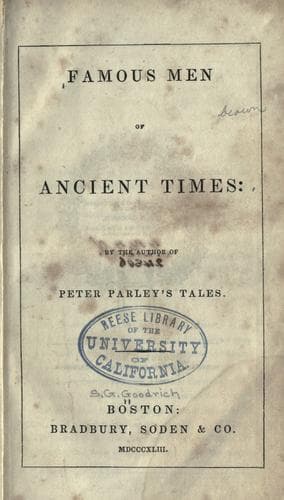
Famous Men of Ancient TimesGoodrich, Samuel G. (Samuel Griswold)
History
Famous Men of Ancient Times
Goodrich, Samuel G. (Samuel Griswold)
Biography -- Juvenile literature; Men -- Biography -- Juvenile literature
“If there be any man,” said the prophet, “whom I have unjustly
scourged, I submit my own back to the lash of retaliation. Have I
aspersed the reputation of any Mussulman? let him proclaim my fault
in the face of the congregation. Has any one been despoiled of his
goods? the little that I possess shall compensate the principal
and the interest of the debt.” “Yes,” replied a voice from the
crowd, “thou owest me three drachms of silver!” Mohammed heard the
complaint, satisfied the demand, and thanked his creditor that he
had accused him in this world, rather than at the day of judgment.
He then set his slaves at liberty, seventeen men and eleven women;
directed the order of his funeral; strove to allay the lamentations
of his weeping friends, and waited the approach of death. He did not
expressly nominate a successor, a step which would have prevented the
altercations that afterwards came so near to crushing in its infancy
the religion and the empire of the Saracens; but his appointment of
Abubeker to supply his place in the function of public prayer, and the
other services of the mosque, seemed to intimate indirectly the choice
of the prophet. This ancient and faithful friend, accordingly, after
much contention, became the first Caliph of the Saracens, though his
reign was closed by his death at the end of two years.
The death of Mohammed was hastened by the force of a burning fever,
which deprived him at times of the use of reason. In one of these
paroxysms of delirium, he demanded pen and paper, that he might compose
or dictate a divine book. Omar, who was watching at his side, refused
his request, lest the expiring prophet might dictate something which
should supersede the Koran. Others, however, expressed a great desire
that the book might be written; and so warm a dispute arose in the
chamber of the apostle that he was forced to reprove their unbecoming
vehemence. The writing was not performed, and many of his followers
have mourned the loss of the sublime revelations which his dying
visions might have bequeathed to them.
Public-domain text, read in full here on John Shaqi.
Reviews
Reviews
No reviews yet
Be the first to share your thoughts on this work.
Join the Discussion
Join the discussion
Sign in to leave a comment or review.
Sign InorCreate an account