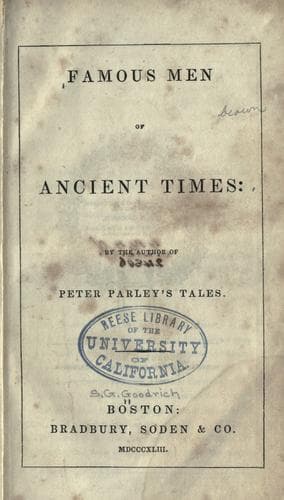
Famous Men of Ancient TimesGoodrich, Samuel G. (Samuel Griswold)
History
Famous Men of Ancient Times
Goodrich, Samuel G. (Samuel Griswold)
Biography -- Juvenile literature; Men -- Biography -- Juvenile literature
That Hannibal was patriotic, is evinced also by the reforms which he
sought to effect in the government of his country. These had for their
object the benefit of the people at large. For this, he obtained the
confidence of the mass, while he incurred the hostility of the few.
It is no evidence against him that he fell a victim to the jealousy
thus excited, for such has too often been the fate of the lover of his
country.
[Illustration]
[Illustration]
ALEXANDER, KING OF MACEDON.
It is now somewhat more than two thousand years since this warrior
flourished; yet his image continues to stand out from the page of
history in bold relief, seeming not only to claim our attention, but to
challenge our admiration. A brief outline of his history may enable us
to judge upon what basis this undying fame is founded.
Alexander was born 354 B. C., on the same day that Erostratus destroyed
the famous temple of Diana at Ephesus, by fire. A wit of the time
remarked that “it was no wonder that the temple of Diana should be
burnt at Ephesus, while the goddess was at Macedon, attending the
birth of Alexander.” Plutarch observes that this witticism was frigid
enough to have extinguished the flames. Philip, Alexander’s father,
being absent at the time of his birth, received three messages in one
day: the first informed him that his general, Parmenio, had won a great
battle; the second, that his horse had gained the prize at the Olympic
games; the third, that his wife had borne him a son.
At the time of Alexander’s birth, Macedonia, which lay north of Greece,
and now constitutes that part of Turkey called Romelia, had become a
warlike and powerful kingdom. Philip was not only an able warrior, but
an ambitious and sagacious statesman. He greatly civilized his own
people, trained them to arms, and added to his kingdom several adjacent
states. By a series of victories and crafty negotiations he had also
become the nominal protector, but real master of Greece. It was against
the insidious policy of Philip that Demosthenes pronounced his caustic
speeches, which gave rise to the term “Philippics.”
Although Philip was ruthless in war and unscrupulous in policy, still
he was a very enlightened prince. He understood many of the arts,
customs and feelings which belong to civilization; nor was he destitute
of noble traits of character. We are told that a Grecian, named
Arcadius, was constantly railing against him. Venturing once into the
dominions of Philip, the courtiers suggested to their prince that he
had now an opportunity to punish Arcadius for his past insults, and to
put it out of his power to repeat them. The king took their advice, but
in a different way. Instead of seizing the hostile stranger and putting
him to death, he sent for him, and then caused him to be dismissed,
loaded with courtesies and kindness.
Public-domain text, read in full here on John Shaqi.
Reviews
Reviews
No reviews yet
Be the first to share your thoughts on this work.
Elsewhere in the archive
Join the Discussion
Join the discussion
Sign in to leave a comment or review.
Sign InorCreate an account