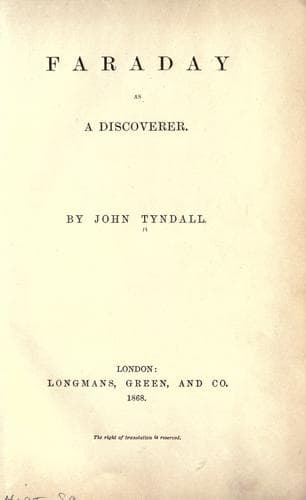
Faraday, Michael, 1791-1867; Physicists -- Great Britain -- Biography
But Faraday at once saw that his induced currents must come into play
here, and he immediately obtained them from an iron disk. With a hollow
brass ball, moreover, he produced the effects obtained by Mr. Barlow.
Iron was in no way necessary: the only condition of success was that
the rotating body should be of a character to admit of the formation of
currents in its substance: it must, in other words, be a conductor of
electricity. The higher the conducting power the more copious were the
currents. He now passes from his little brass globe to the globe of the
earth. He plays like a magician with the earth's magnetism. He sees the
invisible lines along which its magnetic action is exerted, and sweeping
his wand across these lines evokes this new power. Placing a simple loop
of wire round a magnetic needle he bends its upper portion to the west:
the north pole of the needle immediately swerves to the east: he bends
his loop to the east, and the north pole moves to the west. Suspending a
common bar magnet in a vertical position, he causes it to spin round its
own axis. Its pole being connected with one end of a galvanometer
wire, and its equator with the other end, electricity rushes round the
galvanometer from the rotating magnet. He remarks upon the 'singular
independence' of the magnetism and the body of the magnet which carries
it. The steel behaves as if it were isolated from its own magnetism.
And then his thoughts suddenly widen, and he asks himself whether the
rotating earth does not generate induced currents as it turns round its
axis from west to east. In his experiment with the twirling magnet the
galvanometer wire remained at rest; one portion of the circuit was in
motion relatively to another portion. But in the case of the twirling
planet the galvanometer wire would necessarily be carried along with the
earth; there would be no relative motion. What must be the consequence?
Take the case of a telegraph wire with its two terminal plates dipped
into the earth, and suppose the wire to lie in the magnetic meridian.
The ground underneath the wire is influenced like the wire itself by the
earth's rotation; if a current from south to north be generated in the
wire, a similar current from south to north would be generated in the
earth under the wire; these currents would run against the same terminal
plate, and thus neutralise each other.
Public-domain text, read in full here on John Shaqi.
Reviews
Reviews
No reviews yet
Be the first to share your thoughts on this work.
Join the Discussion
Join the discussion
Sign in to leave a comment or review.
Sign InorCreate an account