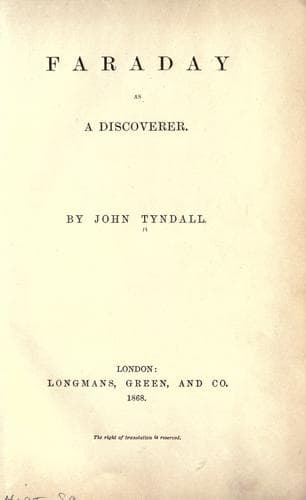
Faraday, Michael, 1791-1867; Physicists -- Great Britain -- Biography
This inference appears inevitable, but his profound vision perceived
its possible invalidity. He saw that it was at least possible that the
difference of conducting power between the earth and the wire might
give one an advantage over the other, and that thus a residual or
differential current might be obtained. He combined wires of different
materials, and caused them to act in opposition to each other, but
found the combination ineffectual. The more copious flow in the better
conductor was exactly counterbalanced by the resistance of the worse.
Still, though experiment was thus emphatic, he would clear his mind of
all discomfort by operating on the earth itself. He went to the round
lake near Kensington Palace, and stretched 480 feet of copper wire,
north and south, over the lake, causing plates soldered to the wire
at its ends to dip into the water. The copper wire was severed at the
middle, and the severed ends connected with a galvanometer. No effect
whatever was observed. But though quiescent water gave no effect, moving
water might. He therefore worked at London Bridge for three days during
the ebb and flow of the tide, but without any satisfactory result. Still
he urges, 'Theoretically it seems a necessary consequence, that where
water is flowing there electric currents should be formed. If a line
be imagined passing from Dover to Calais through the sea, and returning
through the land, beneath the water, to Dover, it traces out a circuit
of conducting matter one part of which, when the water moves up or down
the channel, is cutting the magnetic curves of the earth, whilst the
other is relatively at rest.... There is every reason to believe that
currents do run in the general direction of the circuit described,
either one way or the other, according as the passage of the waters is
up or down the channel.' This was written before the submarine cable was
thought of, and he once informed me that actual observation upon
that cable had been found to be in accordance with his theoretic
deduction.[1]
Three years subsequent to the publication of these researches--that is
to say, on January 29, 1835--Faraday read before the Royal Society
a paper 'On the influence by induction of an electric current upon
itself.' A shock and spark of a peculiar character had been observed
by a young man named William Jenkin, who must have been a youth of some
scientific promise, but who, as Faraday once informed me, was dissuaded
by his own father from having anything to do with science. The
investigation of the fact noticed by Mr. Jenkin led Faraday to the
discovery of the extra current, or the current induced in the primary
wire itself at the moments of making and breaking contact, the phenomena
of which he described and illustrated in the beautiful and exhaustive
paper referred to.
Public-domain text, read in full here on John Shaqi.
Reviews
Reviews
No reviews yet
Be the first to share your thoughts on this work.
Join the Discussion
Join the discussion
Sign in to leave a comment or review.
Sign InorCreate an account