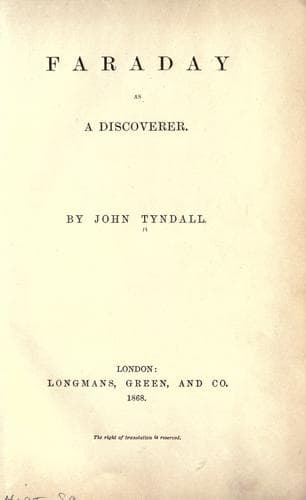
Faraday, Michael, 1791-1867; Physicists -- Great Britain -- Biography
Faraday did, as you know, accompany Davy to Rome: he was re-engaged
by the managers of the Royal Institution on May 15, 1815. Here he made
rapid progress in chemistry, and after a time was entrusted with easy
analyses by Davy. In those days the Royal Institution published 'The
Quarterly Journal of Science,' the precursor of our own 'Proceedings.'
Faraday's first contribution to science appeared in that journal in
1816. It was an analysis of some caustic lime from Tuscany, which had
been sent to Davy by the Duchess of Montrose. Between this period and
1818 various notes and short papers were published by Faraday. In 1818
he experimented upon 'Sounding Flames.' Professor Auguste De la Rive
had investigated those sounding flames, and had applied to them an
explanation which completely accounted for a class of sounds discovered
by himself, but did not account for those known to his predecessors. By
a few simple and conclusive experiments, Faraday proved the explanation
insufficient. It is an epoch in the life of a young man when he finds
himself correcting a person of eminence, and in Faraday's case, where
its effect was to develop a modest self-trust, such an event could not
fail to act profitably.
From time to time between 1818 and 1820 Faraday published scientific
notes and notices of minor weight. At this time he was acquiring, not
producing; working hard for his master and storing and strengthening
his own mind. He assisted Mr. Brande in his lectures, and so quietly,
skilfully, and modestly was his work done, that Mr. Brande's vocation at
the time was pronounced 'lecturing on velvet.' In 1820 Faraday published
a chemical paper 'on two new compounds of chlorine and carbon, and on
a new compound of iodine, carbon, and hydrogen.' This paper was read
before the Royal Society on December 21, 1820, and it was the first of
his that was honoured with a place in the 'Philosophical Transactions.'
On June 12, 1821, he married, and obtained leave to bring his young wife
into his rooms at the Royal Institution. There for forty-six years
they lived together, occupying the suite of apartments which had been
previously in the successive occupancy of Young, Davy, and Brande. At
the time of her marriage Mrs. Faraday was twenty-one years of age, he
being nearly thirty. Regarding this marriage I will at present limit
myself to quoting an entry written in Faraday's own hand in his book of
diplomas, which caught my eye while in his company some years ago. It
ran thus:--
'25th January, 1847. 'Amongst these records and events, I here insert
the date of one which, as a source of honour and happiness, far exceeds
all the rest. We were married on June 12, 1821.
'M. Faraday.'
Public-domain text, read in full here on John Shaqi.
Reviews
Reviews
No reviews yet
Be the first to share your thoughts on this work.
Join the Discussion
Join the discussion
Sign in to leave a comment or review.
Sign InorCreate an account