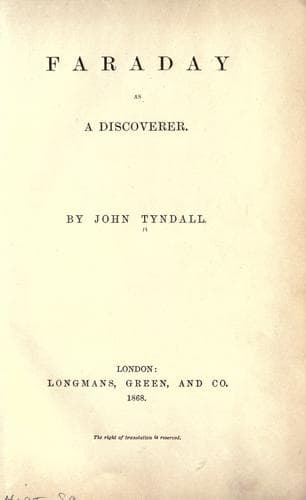
Faraday, Michael, 1791-1867; Physicists -- Great Britain -- Biography
Then follows the copy of the minutes, dated May 21, 1821, which gave him
additional rooms, and thus enabled him to bring his wife to the Royal
Institution. A feature of Faraday's character which I have often noticed
makes itself apparent in this entry. In his relations to his wife he
added chivalry to affection.
Footnotes to Chapter 1
[1] Here is Davy's recommendation of Faraday, presented to
the managers of the Royal Institution, at a meeting on the
18th of March, 1813, Charles Hatchett, Esq., in the chair:--
'Sir Humphry Davy has the honour to inform the managers that
he has found a person who is desirous to occupy the
situation in the Institution lately filled by William Payne.
His name is Michael Faraday. He is a youth of twenty-two
years of age. As far as Sir H. Davy has been able to
observe or ascertain, he appears well fitted for the
situation. His habits seem good; his disposition active and
cheerful, and his manner intelligent. He is willing to
engage himself on the same terms as given to Mr. Payne at
the time of quitting the Institution.
'Resolved,--That Michael Faraday be engaged to fill the
situation lately occupied by Mr. Payne, on the same terms.'
[2] Faraday loved this word and employed it to the last; he
had an intense dislike to the modern term physicist.
[3] To whom I am indebted for a copy of the original letter.
Chapter 2.
Early researches: magnetic rotations: liquefaction of gases:
heavy glass: Charles Anderson: contributions to physics.
Public-domain text, read in full here on John Shaqi.
Reviews
Reviews
No reviews yet
Be the first to share your thoughts on this work.
Join the Discussion
Join the discussion
Sign in to leave a comment or review.
Sign InorCreate an account