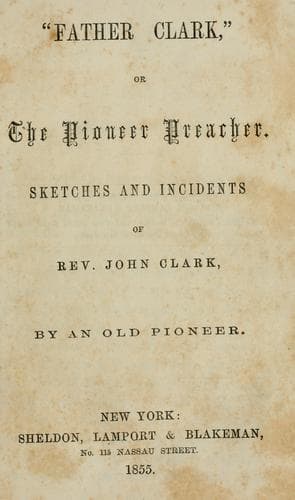
"Father Clark," or The Pioneer PreacherPeck, John Mason
History
"Father Clark," or The Pioneer Preacher
Peck, John Mason
Clark, John, 1758-1833; Methodist Episcopal Church -- Clergy
The inhabitants of St. Louis were in a critical situation. With
evidence of treachery among the officers, who were Spanish; the place
invaded by a force nearly double to the whole population, men, women
and children; and these invaders infuriated with the spirit of war
and plunder, what could they expect but a general massacre! But after
killing and scalping twenty persons in the field and prairie, and
meeting with such determined resistance at the gates, the Indians
retired suddenly, and refused to coöperate with their Canadian allies,
who kept themselves at a safe distance.
The cause of this sudden and unexpected retreat has been a mystery. The
most probable solution is the tradition among the French inhabitants,
that the Indians were told they were going on a war party to fight the
Spaniards; but when they discovered the defenders of the town were all
Frenchmen, and recognized amongst them some of their personal friends,
who had lived and traded in their villages; and that they had been
deceived by British agents, they withdrew in ill-humor with their
employers.
Divers misstatements of this assault have been handed down by writers
and oral tradition. A popular error has been propagated, that Colonel
Clark was at Cahokia, (some say Kaskaskia) and suddenly appeared on the
bank of the Mississippi, opposite the town with a strong force. Colonel
Clark left the Illinois country with all the men whom he could persuade
to re-enlist, the preceding February, went down the Mississippi, and at
the date of the attack was establishing fort Jefferson, below the mouth
of the Ohio. From thence he traveled on foot with a single companion
through the wilderness to Harrodsburg in Kentucky.
The traditional fact of his giving information to Governor Leyba, in
1779, of the projected invasion, and the offer of aid, has caused this
error. The register of the old Catholic church in St. Louis of the
funeral obsequies of the persons massacred, furnishes incontestible
evidence that the attack was on May 26th, 1780.
Aware that a report of his treasonable conduct had been forwarded to
the Governor General at New Orleans, fearful of the consequences, and
unable to sustain the scorn and indignation heaped upon him, Governor
Leyba died shortly after the attack; having poisoned himself, as the
creditable report was. Cartabona, his deputy, performed the functions
of the office until the next year, when Don Francisco Cruzat, the
predecessor of Leyba, and who had been supplanted by him in 1778,
returned and assumed the command a second time.
In a few years after an important change was made in the government
of Upper Louisiana, by the appointment of a commandant-general, or
governor for that province, and a commandant, or lieutenant-governor
for each district. The commandant-general was Don Carlos Dehault
Delassus, and the lieut. governor of St. Louis district was an
intelligent French gentleman of liberal principles, M. Zenon Trudeau.
Public-domain text, read in full here on John Shaqi.
Reviews
Reviews
No reviews yet
Be the first to share your thoughts on this work.
Elsewhere in the archive
Join the Discussion
Join the discussion
Sign in to leave a comment or review.
Sign InorCreate an account