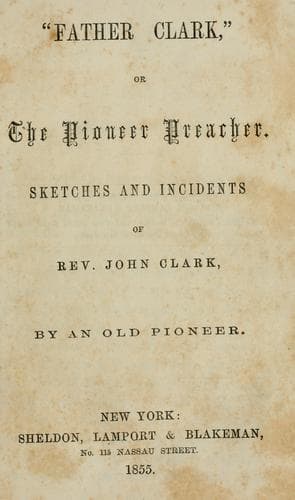
"Father Clark," or The Pioneer PreacherPeck, John Mason
History
"Father Clark," or The Pioneer Preacher
Peck, John Mason
Clark, John, 1758-1833; Methodist Episcopal Church -- Clergy
We have given these facts of St. Louis history to explain why so many
Americans had settled in the province before Father Clark made his
first visit.
The attack on St. Louis from Canada, the detection of the meditated
invasion by Colonel Clark, and the friendly intercourse between the
French citizens of St. Louis and those of Illinois, induced the
authorities of Louisiana to encourage the immigration of Americans from
the United States to the Upper province. To this intent a movement was
made by Don Guardoqui, Spanish minister to the government of the United
States at Philadelphia, as early as 1787, when he proposed a plan of
emigration from the western settlements to the country from Arkansas
to the settlements on the Missouri.[43] Instructions were given to
the commandants regulating the grants of land, and the conditions of
admitting this class of immigrants. Instructions were issued by Gayoso,
commandant-general, the first of January, 1798, from which we give an
extract.[44] No settler was to be admitted in the province who was not
a farmer or mechanic.
Of course practically, this included all who came. The sixth article
provided for a limited degree of toleration to Protestants.
“Liberty of conscience is not to be extended beyond the first
generation; the children of the emigrants must be Catholics.”
[This of course required their baptism in the Catholic form, but
it was not enforced.] “Emigrants not agreeing to this, must not
be admitted, but removed, even when they bring property with
them. This is to be explained to settlers, who do not profess the
Catholic religion.”
We shall see in the sequel, how the liberal minded commandants
interpreted this ordinance.
The seventh regulation, “Expressly recommended to the commandants to
watch that _no preacher of any religion_ but the Catholic, comes into
the province.”
After the attack on St. Louis of 1780, measures were adopted to
fortify the town more effectually, and in 1794 the garrison on the
hill (now Third street, or Broadway) and the Government house were
completed. In 1797, apprehensions were entertained of another invasion
from Canada, and four stone towers, at equal distances, in a circular
direction around the town, and a wooden block-house near the lower
end, were erected. But their chief dependence for protection was the
American emigrants who had been invited into the province by the
liberal policy of grants of land, and the indulgence shown by the
commandants. They were permitted to locate themselves in the country,
and make farms, whereas the French families were required to live in
villages, and cultivate their farms near by under an enclosure in
common. At the transfer of the country in 1804, more than three-fifths
of the inhabitants of Upper Louisiana were English Americans from the
United States.[45]
Public-domain text, read in full here on John Shaqi.
Reviews
Reviews
No reviews yet
Be the first to share your thoughts on this work.
Elsewhere in the archive
Join the Discussion
Join the discussion
Sign in to leave a comment or review.
Sign InorCreate an account