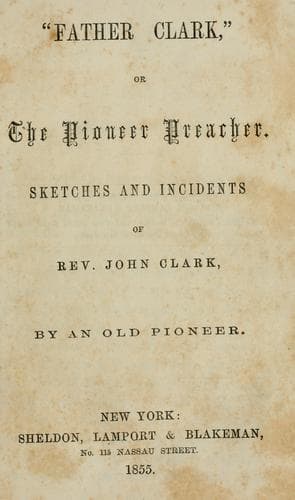
"Father Clark," or The Pioneer PreacherPeck, John Mason
History
"Father Clark," or The Pioneer Preacher
Peck, John Mason
Clark, John, 1758-1833; Methodist Episcopal Church -- Clergy
The Roman Catholic faith was the established religion of the province.
American immigrants were examined by the commandants as to their faith,
but by the use of a pious fiction on the part of the examiners, and the
provision in the ordinances already quoted, large toleration actually
existed.
The mode of examination gave great latitude for Protestants to come
in. A few general and rather equivocal questions were asked, which
persons of almost any Christian sect could consistently answer; such
as, “Do you believe in Almighty God?--In the Holy Trinity?--In the
true, apostolical church?--In Jesus Christ our Saviour?--In the holy
evangelists? etc. An affirmative answer being given to these and other
questions of a general character, “_Un bon Catholique_,” (a good
Catholic) closed the ceremony.
Many Baptists, Methodists, and other Protestant families, settled in
the province, and remained undisturbed in their religious principles.
Much the largest proportion of American Protestants came into the
country after 1794. They held no religious meetings publicly, and had
no minister of the gospel among them. There were about fifty persons
who had been members of Protestant churches in the United States,
in the districts of St. Louis and St. Charles, at the period of Mr.
Clark’s first visit, besides as many more in the districts of St.
Genevieve, and Cape Girardeau.
The Catholic priests of Upper Louisiana received from the Spanish
treasury a stipend rating from $350 to $400 a year, besides the
perquisites for mass, confessions, marriages, and funerals. No tithes
were levied in Louisiana, and hence Protestants and free-thinkers felt
no burdens in pecuniary demands from the priesthood. There were three
curates, one vicar, and a few missionary priests who resided in the
upper province. The rite of marriage must be performed by a Catholic
priest; and it is probable the administration of baptism, or the Lord’s
supper, by a Protestant, would have sent him to prison, but no minister
made the attempt.
The American settlers in general were peaceable, industrious, moral
and well disposed persons, who, from various motives, had crossed the
“Great River;” some from love of adventure--some from that spirit of
restlessness that animates a numerous class of Americans--but a larger
number went with the expectation of obtaining grants of land, for the
trifling expense of surveying and recording the plat. We have been
personally acquainted with many of these emigrants, conversed with
them freely, knew their character well, and have heard so many of
them declare their expectation that in due time the country would be
annexed to the United States, that we have no doubt such an impression
did exist largely. Yet they projected no _filibustering_ enterprise;
no schemes of a revolution; nor were there amongst them any sanguine
spirits at work to excite such feelings.
Public-domain text, read in full here on John Shaqi.
Reviews
Reviews
No reviews yet
Be the first to share your thoughts on this work.
Elsewhere in the archive
Join the Discussion
Join the discussion
Sign in to leave a comment or review.
Sign InorCreate an account