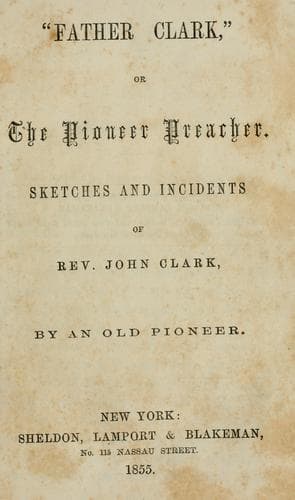
"Father Clark," or The Pioneer PreacherPeck, John Mason
History
"Father Clark," or The Pioneer Preacher
Peck, John Mason
Clark, John, 1758-1833; Methodist Episcopal Church -- Clergy
From the time of the definitive treaty of 1783, the government of the
United States had been negociating with Spain for the free navigation
of the Mississippi river to the ocean, secured, as was understood,
by that treaty. The inhabitants west of the Alleghany mountains were
deeply interested in such a measure. It was a topic of conversation in
all circles, and discussed freely in the newspapers. It is not strange
that the public mind in this valley should entertain the conviction
that by some form of negociation the country would be annexed to the
American Union. They did not realize that a removal to the west of the
great river would expatriate them and their posterity, nor did they
lose their attachment to the Republic by a residence in the dominions
of the crown of Spain.
Such was the character, and such were the circumstances of the people
to whom Mr. Clark was the _pioneer preacher_. Certainly, no minister
of the gospel, in the scriptural sense of that term, ever passed the
boundary before him. He visited the American families from house to
house, in a quiet and peaceable manner, conversed and prayed with
them, and was received with great cordiality. There were men and
women, disciples of Christ, who had not heard the precious gospel for
a long period. A few gathered, on the Sabbath, in some log cabin, with
fearful forebodings. They might be arrested, and, with the preacher,
sent to the _calabozo_,[46] or to the Mexican mines for their heretical
practices. A larger number came out stealthily by night. Mr. Clark
found the American families dispersed over the country, for some miles
distant, and living in log cabins of the most primitive sort. Of the
Baptists who were pioneers to this country before Mr. Clark, we can
call to recollection the names of Abraham and Sarah Musick; Abraham
Musick, Jun., as he was called, to distinguish him from his uncle, and
Terrell, his wife; Adam and Lewis Martin, who were brothers, and their
wives; Mr. Richardson and wife; Mrs. Jane Sullens; Sarah Williams, (who
lived to see her son and four grandsons ministers of the Gospel); Mrs.
Whitley, all in St. Louis district; and David Darst and wife, William
Hancock and wife, Mr. Brown and family, and several others, who settled
in the district of St. Charles, north of the Missouri river. There were
three settlements in the district (now county) of St. Louis, where,
after two or three casual visits, Mr. Clark made regular appointments,
and crossed the river monthly. These were the settlement near the
Spanish pond, north of St. Louis; the settlement between Owen’s station
(now Bridgton) and Florrissant; and the settlement called Feefe’s
creek.[47] He was threatened repeatedly with the _calabozo_, for
violating the laws of the country. M. Trudeau, the lieutenant-governor
of St. Louis district, was a liberalist in principle, who, with his
parents, had been driven out of France by the storm of the revolution,
and their estate confiscated.
Public-domain text, read in full here on John Shaqi.
Reviews
Reviews
No reviews yet
Be the first to share your thoughts on this work.
Elsewhere in the archive
Join the Discussion
Join the discussion
Sign in to leave a comment or review.
Sign InorCreate an account