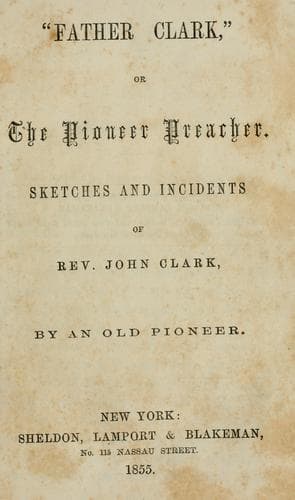
"Father Clark," or The Pioneer PreacherPeck, John Mason
History
"Father Clark," or The Pioneer Preacher
Peck, John Mason
Clark, John, 1758-1833; Methodist Episcopal Church -- Clergy
He obtained the appointment of deputy
commandant, through the influence of the principal French citizens, as
the means of sustaining his aged parents, who had suffered for their
loyalty. He abhorred all kinds of persecution, but, in his official
station, in accordance with the ordinances, he was compelled “to
watch that no preacher of any religion but the Catholic came into the
province.”
Abraham Musick, Jun., who had formed a friendly acquaintance with
the lieut. governor, and, in their social interviews, had given
him information of the distinctive principles of the Baptists, as
contradistinguished from the Catholic and Protestant Pædo-Baptists,
made application to M. Trudeau for liberty to hold meetings in his
house. We give the colloquy in substance as we received it from the
pious and intelligent widow of Mr. M----, twenty-five years after the
interview.
_M._ “My friend, John Clark, is in the country, on a visit to his
friends. He is a good man, peaceably disposed, and will behave as a
good citizen should. The American people desire to hear him preach at
my house occasionally. Will the commandant please give permission,
that we may not be molested? We will hold our meetings quietly, make
no disturbance, and say nothing against the king of Spain, nor the
Catholic religion.”
The commandant was inclined to favor the American settlers, but he was
obliged to reject all such petitions officially, and replied, with
seeming determination:
_C._ “No, Monsieur Musick. I can not permit no such ting; ’tis against
de law; you must all be _bon Catholique_ in dis contree. Very sorry,
Mons. Musick, I cannot oblige you, but I must follow de ‘Regulacion.’”
Discouraged at this decision, in a tone so magisterial, Mr. M. regarded
any farther effort hopeless, and arose to depart from the office, when,
with a gracious countenance, the commandant said:
“Sit down, Mons. Musick; please sit down; I soon get dis paper fix for
dese gentlehomme who wait; and den we talk. You must eat my dinner,
and drink a glass of my _bon vin_. You and I are good friend, though I
cannot let you make a church house.”
After dispatching the business on hand, M. Trudeau insisted on the
company of Mr. Musick to dinner. While discoursing with volubility in
his imperfect English, the wily commandant adverted to the petition,
so unceremoniously rejected in the office.
_C._ “You understand me, Monsieur Musick, I presume. You must not
put--what do you call him--_un colcher_,[48] on your house and call it
a _church_;--dat is all wrong,--you must make no bell ring. And now
hear me, Mons. Musick, you must let no man baptize your _enfant_ but de
parish priest. But if your friend come to see you--your neighbor come
there,--you _conversez_;--you say prayer;--you read Bible--you sing
song--dat is all right--you all _bon Catholique_.”
Public-domain text, read in full here on John Shaqi.
Reviews
Reviews
No reviews yet
Be the first to share your thoughts on this work.
Elsewhere in the archive
Join the Discussion
Join the discussion
Sign in to leave a comment or review.
Sign InorCreate an account