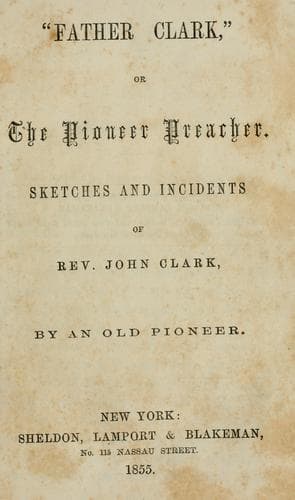
"Father Clark," or The Pioneer Preacher — John Shaqi
"Father Clark," or The Pioneer PreacherPeck, John Mason
History
"Father Clark," or The Pioneer Preacher
Peck, John Mason
Clark, John, 1758-1833; Methodist Episcopal Church -- Clergy
This incident made a lasting impression on the mind of Clark. The
manner of his approach the preceding night, the long and somewhat
religious conversation he held, the premonition he seemed to entertain
of the approaching calamity, and his sober, orderly and correct life
left the fixed impression that the gunner was a Christian. A young man
had his skull fractured by the same gun, and Clark stood by and saw the
surgeon trepan him, while he exhibited the greatest degree of fortitude
and patience. The wounded men were all sent to the hospital in Jamaica,
where this youth died.
The fleet they had left behind under Rodney soon had an opportunity
to act on the offensive. The French fleet that had been blockaded
were reinforced by Count de Grasse, and made an attempt to join the
Spanish fleet. They were followed by Admiral Rodney, who sunk one of
the largest vessels and captured five others. For this act of naval
heroism, he was created a baronet, had a pension of two thousand pounds
sterling per annum settled on him by the crown, and at his decease in
1792, a monument was erected in St. Paul’s church, London.
The Tobago, on which Clark was, needing repairs, she was hove down
for the purpose in Port Royal. In consideration of his fidelity and
good conduct after his attempt to desert, Mr. Clark was promoted to
the station of quarter-master. This did not reconcile him to the war,
nor to the despotism of the officers, and the sufferings of the men
on board of a war vessel. He was still resolved on escaping the first
opportunity, for as he had been forced on board a man-of-war, in
violation of his rights, he thought it no wrong to escape the first
opportunity. In company with two other young men he escaped one night,
and reached Savannah La Mar, a port on the south-western part of the
Island. Here he found a ship taking in lading for London; and so
weak-handed, that they scarcely had men enough to heave the anchor.
Clark and his comrades were employed at once and helped load the ship;
and in great haste to be off, or the time of their insurance would
expire. “Here,” he states, “for the first and last time in my life, I
worked on the Sabbath for double wages.”
Public-domain text, read in full here on John Shaqi.
Reviews
Reviews
No reviews yet
Be the first to share your thoughts on this work.
Join the Discussion
Join the discussion
Sign in to leave a comment or review.
Sign InorCreate an account