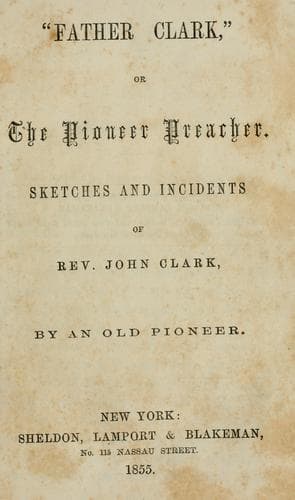
"Father Clark," or The Pioneer Preacher — John Shaqi
"Father Clark," or The Pioneer PreacherPeck, John Mason
History
"Father Clark," or The Pioneer Preacher
Peck, John Mason
Clark, John, 1758-1833; Methodist Episcopal Church -- Clergy
When the Captain paid off Clark and his companions, he used a stratagem
to induce them to work the ship to England. The wages then were forty
guineas and forty gallons of rum for the voyage; but John Clark had
resolved to visit his brother, according to a promise he made his
mother when he parted with her, and no high wages or other inducement
would tempt him to break his promise. The Captain professed great
generosity, and proposed treating Clark and a young man who was to be
his traveling companion, to French brandy; and as Clark suspected with
drugged liquor, in order to detain them. He drank but little, while his
comrade praised the liquor and took it freely. They had not proceeded
far before the young man’s legs gave out, and they were compelled to
stop at a strange house till next morning. During the night, the young
man was robbed of all he had, and being destitute, Clark, as a genuine
sailor, and benevolent withal, divided his purse with his unfortunate
friend. And he moralizes on it in this language:--“So here I saw the
fruits of Sabbath-breaking and trifling company.” But on looking back
on the events of providence from the pinnacle of three score and ten,
he says:--
“I now find that it was the interposition of a particular
providence of Him, who is loving and mindful of all his creatures,
that the forty guineas and forty gallons of rum, and the French
brandy made no impression on my mind to induce me to alter my
intentions, and especially my promise to the best of mothers.”
He learned at a later period, that though the ship got to her place of
rendezvous, yet before the fleet was ready to sail to England, it was
overtaken by a most furious hurricane, and the ship he aided to load,
was stranded, about a quarter of a mile from the beach. The cargo was
lost, and the wicked Captain and every sailor on board perished. Clark
adds, “So fatal was that storm on that ungodly people, (the inhabitants
of Savannah la Mar,) that there was scarcely as many left, as would
bury the dead in proper season.”
Mr. Clark traveled across the Island to find his brother, and then
went to work to obtain money enough to purchase decent clothes,
before he would venture into the presence of his brother, who lived
in a decent family, and was much respected. He earned money, but
Providence seemed to frown on him, for he lost it, and all he had. So
he says, “I resolved at last to see my brother, just as I was in my
tarpaulin dress, as sinners ought to come to the Saviour, without any
righteousness of their own.”
Public-domain text, read in full here on John Shaqi.
Reviews
Reviews
No reviews yet
Be the first to share your thoughts on this work.
Join the Discussion
Join the discussion
Sign in to leave a comment or review.
Sign InorCreate an account