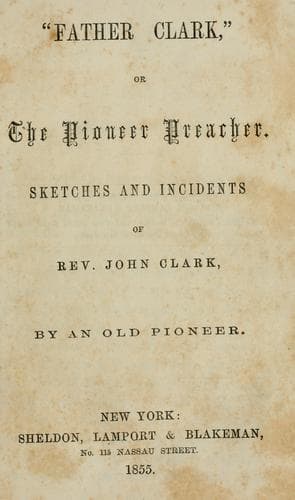
"Father Clark," or The Pioneer PreacherPeck, John Mason
History
"Father Clark," or The Pioneer Preacher
Peck, John Mason
Clark, John, 1758-1833; Methodist Episcopal Church -- Clergy
Mr. Clark now felt his mind relieved from the fear of recapture, but
the respite did not last long. For wages he had nineteen dollars per
month, and a complete asylum from the dangers to which he had been
exposed; plenty of good rations, and very little to do; so he had
two-thirds of his time to improve his mind, which he did not neglect.
But God had wise and gracious designs to accomplish by him, and his
measure of afflictions was not full. His rest was of short duration,
for the sloop was ordered down to Charleston to undergo repairs. There
he was peculiarly exposed to apprehension as a deserter, and knew not
how to escape detection. But the Friend of mankind provided another
asylum, as unexpected as his former deliverances. Connected with the
remnant of the British army that still occupied Charleston, were three
Scotchmen, brothers, who came from his native district. They were
tailors, and employed in altering and fitting the military clothing,
so as to suit each person. With them he became acquainted, and they
concealed him until they were about to be shipped off with the regiment
to New Providence. They told him, in confidence, their parents lived in
North Carolina, that the time of their enlistment had nearly expired,
that they disliked the army, and desired to escape to a country that
was now free. Finally, they entreated Clark to procure a boat, and take
them across Ashley river; and if he wished to accompany them, to obtain
a man to row the boat back to Charleston. This was a providential
opening for Clark to escape, and he engaged his friend Stewart to help
them off.
At eight o’clock at night, Clark, the three tailors, and Stewart as
boatman, were on the water, and hailed by every ship they passed:
“Boat ahoy--what boat is that?” Clark regularly responded in the true
marine accent, “_Guard-boat_;” and thus they escaped unmolested. The
last ship they passed ordered them to stop and come on board, but they
kept on directly towards the margin of a large swamp that lay close by
the river. They intended to turn up the river when on the border of
the swamp, and land on dry and firm ground above. After considering
themselves out of danger, they leisurely plied two oars, while Clark
sat in the stern and steered. Not a word had been spoken by the party,
until one of the men broke silence in a low but emphatic tone, “Lord,
have mercy on us--there’s a boat close on us--put ashore--put ashore!”
Public-domain text, read in full here on John Shaqi.
Reviews
Reviews
No reviews yet
Be the first to share your thoughts on this work.
Join the Discussion
Join the discussion
Sign in to leave a comment or review.
Sign InorCreate an account