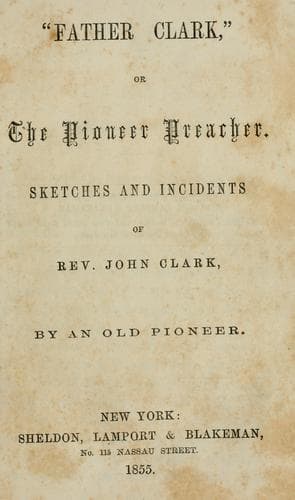
"Father Clark," or The Pioneer Preacher — John Shaqi
"Father Clark," or The Pioneer PreacherPeck, John Mason
History
"Father Clark," or The Pioneer Preacher
Peck, John Mason
Clark, John, 1758-1833; Methodist Episcopal Church -- Clergy
Clark instantly put the boat towards the shore, struck the muddy bank,
and all plunged into the swamp but Stewart, who turned down stream.
A palmetto swamp, when covered with water, is a horrible place in
day-light--what must it have been to these wretched wanderers in a
dark night! What the boat was after that alarmed them, or who manned
it, they never learned. It might have been sent from the last ship who
suspected the “guard-boat” was not its real character; or it might have
contained a party of runaways like their own; or some of the native
inhabitants might have made a stealthy visit to town.
Mr. Clark and his friends were frequently up to their knees in mud and
water, and tearing their clothes and skins with the rough palmetto
leaves. The Scotch tailors were excessively frightened, quite panic
struck, expecting every moment to be made prisoners; or perhaps
shot down in the swamp. The grass was higher than their heads, and
they could not see five yards distant. Clark allayed their fears by
assuring them there was no danger from soldiers or marines, for no
person, unless insane, would attempt to follow them in such a swamp. He
urged them to keep together while he led the party. After a terrible
struggle, they got across the swamp about four o’clock in the morning.
Next day they secreted themselves in a thicket and rested till night,
and then traveled on a south-western course by the direction of the
stars. They knew the camp of General Marion was somewhere in the pine
barrens, and steered their course in that direction. Next day they
were so far within the American lines, they ventured to call on the
inhabitants and found them truly generous, and were made welcome and
comfortable. The day following they reached Marion’s camp, reported
themselves as deserters from the British in Charleston, and were
received by the heroic General and his men with true politeness.
Next day the three Scotch tailors applied for passports to North
Carolina, and Clark for one to Georgetown in South Carolina, which
were readily granted. Though the war had practically ended, peace had
not been proclaimed, and every thing was in an unsettled state. Mr.
Clark reached Georgetown, sixty miles north of Charleston, but found
no employment there. The British had evacuated the place, but the
inhabitants were left destitute, and subsisted on rations furnished
by the American army, and every thing was in confusion. Being almost
destitute of clothes and money, Mr. Clark engaged for a short voyage
on a coasting vessel, and came very near being captured by a British
whale-boat. It was only by a desperate effort they escaped. Soon after
returning from that trip, an American row-galley, with thirty oars when
she had a full complement of seamen, came into port. She was armed with
swivels, muskets and cutlasses, and bound on a cruise to Savannah.
As the boat wanted seamen, Clark obtained a berth on board. On their
voyage they lay by one night at Bull’s Island, and in the morning
Public-domain text, read in full here on John Shaqi.
Reviews
Reviews
No reviews yet
Be the first to share your thoughts on this work.
Join the Discussion
Join the discussion
Sign in to leave a comment or review.
Sign InorCreate an account