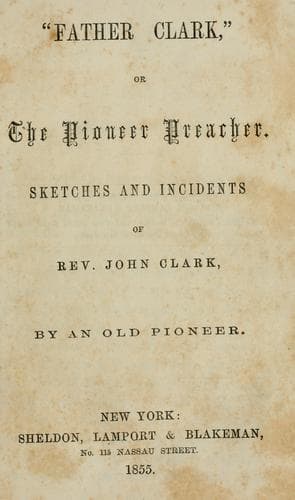
"Father Clark," or The Pioneer Preacher — John Shaqi
"Father Clark," or The Pioneer PreacherPeck, John Mason
History
"Father Clark," or The Pioneer Preacher
Peck, John Mason
Clark, John, 1758-1833; Methodist Episcopal Church -- Clergy
Retires to the Back Settlements in S. Carolina.--Teaches a School.
--Self-righteousness.--His Experience for Twelve Months.--
Despondency.--Reads Russell’s Seven Sermons.--Conversion and
firm Hope.--Removes to Georgia and Becomes a Teacher there.--
First Methodist Preachers in that Quarter.--Mr. Clark joins the
Society.
It was early in the month of March, 1785, that Mr. Clark, after much
struggling of mind and conscience, came to the determination to quit
the seas and become a religious man. The captain and hands were anxious
he should remain, and make the voyage with them to London. The only
defect they perceived in his character as a sailor and officer, was,
his desponding temper, and singular habit of being much alone. None
of his friends knew the nature of his troubles; none could sympathize
with him; and had he known himself and the true nature of the Christian
religion, he might have exclaimed with the ancient patriarch,
“Miserable comforters are ye all.”[13] But he then had no clear views
of gospel truth, nor how a holy and righteous God could justify and
save a sinner consistent with his law which saith--“The soul that
sinneth, it shall die.”[14] But he can best describe his own case in
the language he left in the sketch before us.
“I have already mentioned being afflicted with that tormenting fear
that precedes repentance, and which is unspeakably great. Had I
then known as much of the gospel as I now do, I need not have made
such mistakes as I did, nor suffered the hundredth part I was made
to suffer. For I firmly believe that when an awakened sinner can
say with all his heart, ‘God be merciful to me a sinner,’ like the
publican,[15]; or with Saul of Tarsus, ‘Lord, what wilt thou have
me to do?’[16]; or in the language of one of our sweetest hymns,
‘Here, Lord, I give myself away;
’Tis all that I can do;[17]’
he is then in a state of salvation, though he may not have received
the spirit of adoption.[18]
Public-domain text, read in full here on John Shaqi.
Reviews
Reviews
No reviews yet
Be the first to share your thoughts on this work.
Join the Discussion
Join the discussion
Sign in to leave a comment or review.
Sign InorCreate an account