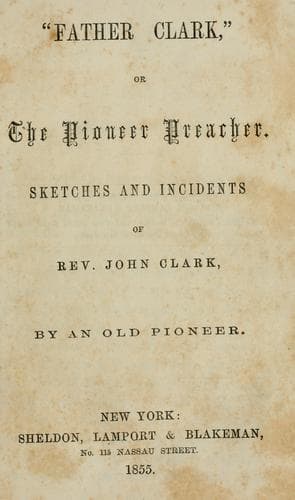
"Father Clark," or The Pioneer PreacherPeck, John Mason
History
"Father Clark," or The Pioneer Preacher
Peck, John Mason
Clark, John, 1758-1833; Methodist Episcopal Church -- Clergy
“I had been in great distress as a sinner, off and on for more than
two years. At times I would be in the greatest distress, and have a
horror of conscience beyond description, and then it would wear off
and I would return to my sinful courses. The first of my permanent
conviction was while in the port of Charleston in March, 1785,
after I had engaged to make a voyage to London as second mate, when
I became continually alarmed, lest if I went to sea another voyage
I should never see land, nor the face of God in peace; my day of
grace would be past. In this awful distress of mind I obtained my
discharge, and under this salutary but distressing conviction, I
set out for the back settlement of South Carolina. On Saturday I
came to a tavern house near the Eutaw Spring, and told the family,
I made it a matter of conscience not to travel on the Sabbath, and
wished to tarry with them till Monday. But they misunderstood my
case, and got some of the neighbors to watch the house on Sunday
night; imagining I was a robber, and had accomplices to aid in
robbing the house. But I did not blame them, for I felt deeply my
wickedness against God, and appeared to my self worse than any
robber on earth.
“On Monday morning I fell in company with some backwoods people,
who had been to Charleston and were going to Fishing river
settlement on the frontiers. Both parties soon became well suited;
for I wanted to teach school, and they wanted a teacher. They
treated me kindly, and I went home with them, and in a few days
a school was made up, and I engaged to teach for them one year.
I now endeavored to abstain from every appearance of evil, read
the Scriptures, and prayed in secret several times in a day. I
was so far from knowing the gospel method of salvation, that,
notwithstanding the instruction given me in childhood, from the
Bible and the Presbyterian catechism, I sincerely thought that true
religion consisted only in outward reformation of conduct. My moral
and serious deportment surprised my employers, who were irreligious
and not over much righteous. They thought it very singular that a
man who had followed a sea-faring life, should be so humble and
religious, and often spoke of it. But they no more comprehended the
state of my mind, nor understood my case than they could lessons in
Latin, Greek, or Hebrew.
Public-domain text, read in full here on John Shaqi.
Reviews
Reviews
No reviews yet
Be the first to share your thoughts on this work.
Join the Discussion
Join the discussion
Sign in to leave a comment or review.
Sign InorCreate an account