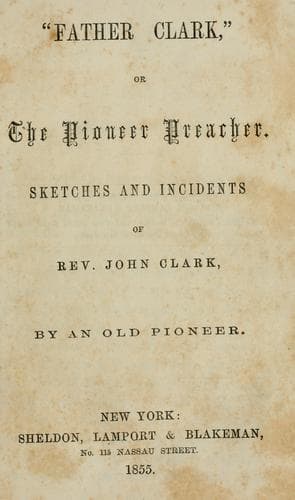
"Father Clark," or The Pioneer PreacherPeck, John Mason
History
"Father Clark," or The Pioneer Preacher
Peck, John Mason
Clark, John, 1758-1833; Methodist Episcopal Church -- Clergy
We do not find in his narrative any account of religious meetings, or
that he heard any one preach for more than a year; nor can we find any
evidence of any church having been organized in this remote settlement,
by any denomination. His school, which had been a large one, closed a
few weeks after he met with the change by which he passed from death to
life. About that period the country south of the Savannah river, now
in the middle part of Georgia, was new, and attracted the attention of
a large immigration from Virginia, and Mr. Clark supposed the work of
surveyors would be in demand. He thought he might obtain a contract,
and then look out and purchase land for a farm and settle down for
life. But he piously observes, after nearly half a century had past
away, “The Author of all events had a higher and more responsible
calling than any that occurred to my mind, and that was to preach the
gospel.”
He went to Georgia, to the country on Broad river, a branch of the
Savannah, some where in the region of the present counties of Elbert,
Wilkes, Oglethorpe and Madison, then all new, and to which immigration
was rapidly tending. But he found no demand for surveying, and again
took up a school, near Colonel Wootten’s residence on Broad river.
A school was raised in the following manner. The teacher, after
consulting some of the heads of families, and learning the probability
that a sufficient number of pupils could be obtained to justify the
engagement, on his part, drew up an article in the neatest style
of penmanship he could, forming a contract between himself and the
signers; he engaging to teach the branches named, at a certain rate per
quarter, and they engaging to pay him a specified sum at the close of
each term. The subscribers would put opposite their names the number of
scholars they engaged to pay for, and if they sent more, the expense
would be in proportion; if less, they were still bound to pay their
subscriptions. A popular teacher would soon have a third more scholars
than at first subscribed. This mode of contract for teaching the common
English branches has been almost universal through the south-western
States, and prevails to this day. In some instances two or three
persons will make a contract with a teacher, and bind themselves to
pay a salary, and then look to their neighbors to aid in making up the
school.
Public-domain text, read in full here on John Shaqi.
Reviews
Reviews
No reviews yet
Be the first to share your thoughts on this work.
Join the Discussion
Join the discussion
Sign in to leave a comment or review.
Sign InorCreate an account