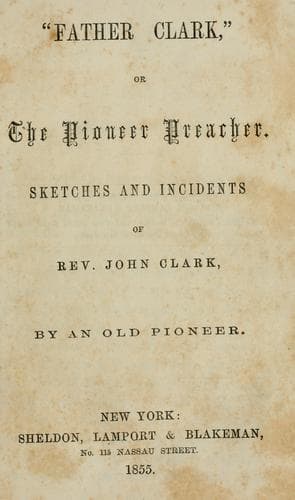
"Father Clark," or The Pioneer PreacherPeck, John Mason
History
"Father Clark," or The Pioneer Preacher
Peck, John Mason
Clark, John, 1758-1833; Methodist Episcopal Church -- Clergy
The school houses, if that term be applicable to the most inferior
of the whole race of “log-cabins,” were constructed of rough, unhewn
logs, with a chimney of sticks and clay at one end; the door-way in
front, and the shutter, if it had one, made of split slabs or boards.
A log cut out of one side left an aperture for a window, and a slab
placed under it, running the length of the room answered the purpose
of a writing-desk. The floor was of earth and seldom cleansed. The
surrounding forest, in the border of which this rough cabin was
located, furnished ample supplies of fuel, and a spring of water near
poured out the refreshing and primitive draught for the thirsty pupils.
About the time Mr. Clark began his school, as he states,
“Two Methodist preachers, by name of John Major and Thomas
Humphries, formed a circuit in those parts, and preached at Col.
Wootten’s house, where I boarded. They pleased me so well that I
joined them.”
Turning to the Minutes of the Methodist Conference, we find the names
of these ministers placed on the Georgia circuit for 1786.[21] Their
labors were abundant and efficient, and several societies were formed
in that part of Georgia.
CHAPTER V.
Appointed Class Leader.--Desires to Visit his Native Country.--
Takes a Berth on the Royal George.--Singular Notions on Board.
--A Storm.--Interview with Tom Halyard.--His Conversion.--
Arrival in London.--Sabbath Morning.--Visits the Foundry and
hears Rev. John Wesley.--Parting with Halyard.--Sails for
Inverness.
We are unable to give anything very definite about the religious
employment of Mr. Clark while he remained in Georgia. He was prompt
and gifted in prayer-meetings, and before many months was appointed
class-leader. We never learned when he commenced regular preaching.
Without a license he gave exhortations in the prayer-meetings; but his
private conversations were probably the most effective means at that
period in bringing sinners to Christ.
Gradually, and with many misgivings, on his part, his mind became
impressed with the duty of preaching the gospel to his fellow men. He
was meek, modest, humble, and thought far less of his gifts than others
did. His sensitive conscience shrunk at undertaking a work for which he
felt so poorly qualified, and we suppose he did not appear before the
public as a preacher until after his return from his native country.
His amiable temper, courteous manners, and kind feelings, without any
effort on his part, gained him the confidence and good will of all with
whom he held intercourse.
Public-domain text, read in full here on John Shaqi.
Reviews
Reviews
No reviews yet
Be the first to share your thoughts on this work.
Join the Discussion
Join the discussion
Sign in to leave a comment or review.
Sign InorCreate an account