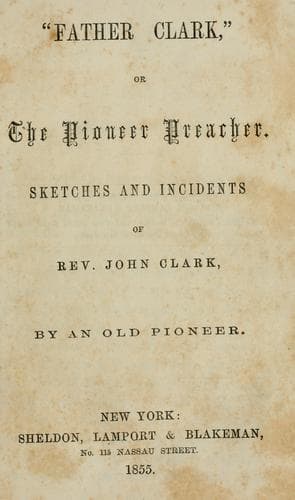
"Father Clark," or The Pioneer PreacherPeck, John Mason
History
"Father Clark," or The Pioneer Preacher
Peck, John Mason
Clark, John, 1758-1833; Methodist Episcopal Church -- Clergy
It was not more than one or two years after he joined the Methodists
that he resolved on a visit to his native land. He had received the
avails of teaching for several terms; his dress was plain, cotton
homespun, and cost but little; and his board had been gratuitously
bestowed by Colonel Wootten. It was a beautiful morning in April that
he led for the last time, by the solicitations of his host, in the
family devotions, and after breakfast, and again singing a favorite
song, he gave the parting hand to each of the family, white and black.
“I’ll go with you, brother Clark, to the forks of the road,” said the
venerable Colonel. As they walked along the lane, Clark thought, though
kindly repulsed before, he would again tender payment for his board and
several articles of clothing he had received as gratuities, and he
mentioned the subject as they arrived at the junction where they must
part. “No, my dear brother,” said the kind-hearted old Methodist, “you
have done a heap more for my family than they can ever do for you. For
until you talk’d to that wayward boy, our George, who was wild like,
and had been after cards and whiskey, I felt orfully afeared he would
be lost and ruined te-totally. But when I know’d you’d tuk him in
hand, and I’d he’rn you pray so all-graciously for him in the tobacco
house, I sort’r pluck’d up heart, and concluded my poor prayers for him
would’nt do no harm. So I prayed too as hard as I could. An’ now he’s
so steady and cheerful, and sings so pretty sin’ he join’d Society.--O,
brother Clark, I hate to part with you; but do pray for me and mine,
when you’re on the great ocean;--and should you ever get back ag’in
to Georgia, remember my house’s your home, as long as I live. And ef
George lives and holds out as he’s begun, he’ll never let you want, for
I do believe he loves you better nor his father and mother.”
The old Colonel was full and he could say no more--his heart was
gushing out of his eyes like a shower of rain, as he gave the hand of
Mr. Clark such a parting squeeze as caused him never to forget this old
Methodist brother.
He might have paid his passage and gone in the cabin of one of the slow
sailing vessels of that period, which were usually from two to three
months in crossing the ocean to Europe. But though he never knew the
feeling of avarice;--though he never hoarded up money for its own sake,
but believed steadfastly in the same providence that clothes the lilies
of the field, and feeds the birds of the air, he went aboard like a
true-hearted sailor, before the mast. Arriving at Charleston, he found
the Royal George, a trim, snug, merchant ship, just fitting out for the
port of London, and shipped as a regular seaman.
Public-domain text, read in full here on John Shaqi.
Reviews
Reviews
No reviews yet
Be the first to share your thoughts on this work.
Join the Discussion
Join the discussion
Sign in to leave a comment or review.
Sign InorCreate an account