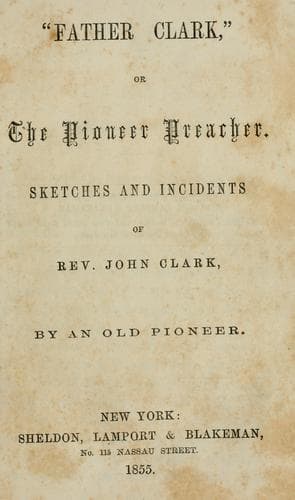
"Father Clark," or The Pioneer PreacherPeck, John Mason
History
"Father Clark," or The Pioneer Preacher
Peck, John Mason
Clark, John, 1758-1833; Methodist Episcopal Church -- Clergy
Time fled away rapidly in their affectionate intercourse. Mr. Clark
visited such of his old acquaintance as were living in the vicinity,
amongst whom were several distant relatives. His habits of cheerfulness
and his earnest religious conversation filled them with surprise. They
did not quite relish so much spirituality and holy fervor. Some were
eager for disputation on doctrinal points, and tenacious of their
metaphysical speculations. They could repeat whole paragraphs from
the larger and shorter catechism, and numerous texts of Scripture;
and as Clark thought, with frequent misapplications. Not a few
could talk eloquently about the “Solemn League and Covenant,” and
“David’s psalms,” while they condemned in the strongest language the
versification of the pious Watts. But his story of his long and pungent
conviction of sin, the views he entertained of the sinfulness of
fallen, corrupt human nature, and the sensations of the new birth, and
the joyful emotions of living in communion with God daily, were matters
too abstruse and incomprehensible for their conceptions.
The most of persons with whom he conversed were very orthodox,
according to the creed of their forefathers and the catechism in which
they had been taught from childhood. All were church members and had
been from infancy. They believed in original sin, effectual calling,
divine decrees, fore-ordination, and final perseverance. They were
quite clear in the doctrine of justification, and redemption in Christ;
but Mr. Clark could not find many who could narrate what he called “an
experience of grace;” his sister and a few others excepted.
The parting hour soon came, but the scene was too sacred to be exposed
to vulgar gaze. On a pleasant morning, a modest looking man, about
thirty years of age, drest in a sailor’s garb, with a change of
clothes, tied up in a parti-colored handkerchief, was seen walking
pensively along the highway towards the city and port of Inverness.
The Caledonian shop-keeper was visited, but no persuasion could induce
the traveler to tarry. A coasting vessel lay at the wharf; and thither
John Clark wended his way. He had visited the port a few days previous,
engaged a berth as an ordinary seaman, and knew the day she was to sail
for London. In a few hours, the wind being fair, they were moving down
the channel of the Firth of Moray.
CHAPTER VI.
At Moorfield in London.--Returns to Georgia.--Received as a
Preacher on Trial.--Richmond Circuit.--Testimonials.--
Character as a Preacher.--Walked the Circuit.--Views on the
Methodist Episcopal Government.--Views on Slavery.--Blameless
Habits.--Thoughts on Marriage.--Love cured by Prayer.--
Gradual change of Views.--Contemplates a New Field.--Quarterly
Conference.--Conscientious Scruples.--Philanthropy to Negroes.
--Withdraws from the Conference.--Parting Scene.
Public-domain text, read in full here on John Shaqi.
Reviews
Reviews
No reviews yet
Be the first to share your thoughts on this work.
Join the Discussion
Join the discussion
Sign in to leave a comment or review.
Sign InorCreate an account