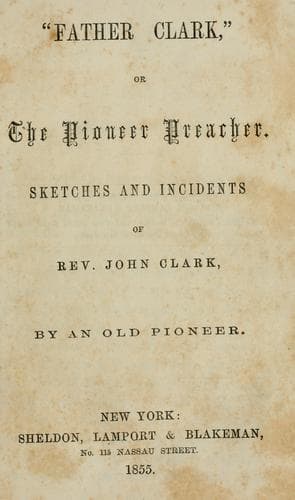
"Father Clark," or The Pioneer Preacher — John Shaqi
"Father Clark," or The Pioneer PreacherPeck, John Mason
History
"Father Clark," or The Pioneer Preacher
Peck, John Mason
Clark, John, 1758-1833; Methodist Episcopal Church -- Clergy
In a few days Mr. Clark found himself in London, and located at a
cheap and retired boarding house in a pious Methodist family. He now
sought acquaintance with several of the more intelligent class of Mr.
Wesley’s preachers, told them his trials and convictions of duty, and
solicited advice. He was directed to the publications of Mr. Wesley,
and also those of Rev. John Fletcher, of Madeley, and by reading and
conversations with the venerable John Wesley, who treated him with
great kindness, he obtained full and clear views of the doctrines they
taught, the discipline they enforced, and their reasons for separate
action from the Church of England.
We have no facts to narrate particulars of the extent of Mr. Clark’s
studies, nor how long he remained in the vicinity of Moorfields.
His interviews with the venerable founder of Methodism, then in
the 85th year of his age, were frequent, and as he thought highly
instructive. And though in a few years he found reasons to withdraw
from the society he founded and the creed and discipline he adopted, he
often referred to him in his preaching and private conversations as the
“great and good Mr. Wesley;” and he would state his views on various
points with accuracy and in kind and courteous language. He also
became acquainted with the writings and peculiar views of the noted
German Bengel, or, as his name was given in Latin, _Bengelius_, and
imbibed some of his peculiar notions. Those especially relating to the
millennium found in Bengel’s exposition of the Book of Revelation, were
often given by Father Clark. Bengel figured up the periods, and taught
that the forty-two months, or twelve hundred and sixty days, expired
in 1810, and the Millennium would commence in 1836. The Millennium,
in the sense Father Clark understood it, was not the _personal_, but
the more gracious and glorious reign of Christ on earth as Mediator
and Saviour. On this topic he would dwell with a holy ecstacy, while
his great modesty and humility led him to express himself as uttering
the opinions of a man merely. He never attempted to make proselytes to
speculations or opinions, but to Christ and entire submission to him.
Public-domain text, read in full here on John Shaqi.
Reviews
Reviews
No reviews yet
Be the first to share your thoughts on this work.
Join the Discussion
Join the discussion
Sign in to leave a comment or review.
Sign InorCreate an account