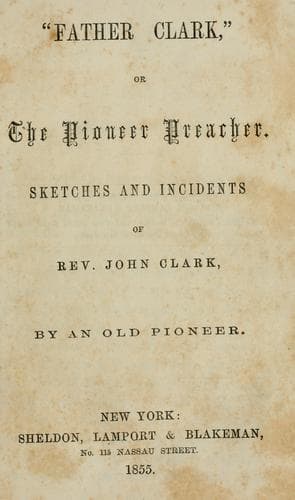
"Father Clark," or The Pioneer PreacherPeck, John Mason
History
"Father Clark," or The Pioneer Preacher
Peck, John Mason
Clark, John, 1758-1833; Methodist Episcopal Church -- Clergy
As a Methodist preacher, he was faithful in the ministry, and
successful in the conversion of sinners. We have seen persons who were
under his ministerial charge, and who spoke of him in strong terms, as
an interesting and spiritually minded preacher. Of these we will name
one, Mr. Thomas Hatton, who resided in 1834 in the upper part of Boone
county, Mo., an old man, whom we visited for the purpose of learning
the characteristics of the ministry of Father Clark in Georgia. Mr.
Hatton was a class-leader and steward on the circuit of Mr. Clark in
1794. His house was one of the preaching stations, and he was with him
at the quarterly conferences in the district, and spoke of him as a
lively, spiritual preacher, greatly beloved by the people, and his
labors as very successful. He _walked_ the circuit, and could not be
induced by his brethren to ride a horse. When asked for the reasons of
his objections to traveling on horseback, he pleasantly remarked, “The
Saviour walked on his preaching excursions in Judea.” There were other
reasons assigned, and to his intimate friends he would say, “As long as
my fellow creatures are made beasts of burden, I cannot feel easy on
horseback.” The fact is, he had never been accustomed to exercise on
horseback, had no skill in managing one, and was distressingly fearful
he should injure the horse, or the horse would harm him. No animal
exceeds a horse in sagacity to find out the feelings and fears of his
rider, and his behavior corresponds. No man felt more uncomfortable
than Father Clark on horseback, and hence he preferred walking, until
it became to him the least fatiguing mode of traveling.
We have given a sketch of his strong feelings and conscientious
principles in favor of personal liberty when pressed on the man-of-war.
These feelings and principles increased and became the more firmly
established as he advanced in life. He never disguised his sentiments;
and never announced them in any public form, without the clearest
conviction of duty and in the way of doing good. Mr. Hatton stated
that generally on his circuit he put up at houses where there were no
slaves, while his intercourse and demeanor were such as to give no
offense, or excite suspicions of improper designs.
Public-domain text, read in full here on John Shaqi.
Reviews
Reviews
No reviews yet
Be the first to share your thoughts on this work.
Join the Discussion
Join the discussion
Sign in to leave a comment or review.
Sign InorCreate an account