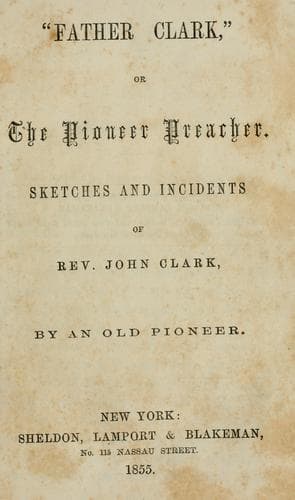
"Father Clark," or The Pioneer PreacherPeck, John Mason
History
"Father Clark," or The Pioneer Preacher
Peck, John Mason
Clark, John, 1758-1833; Methodist Episcopal Church -- Clergy
The same views of equality and freedom, led him to investigate,
prayerfully and scripturally, the ecclesiastical government and code of
discipline instituted by Mr. Wesley, and introduced into the American
conferences. Personally, and as a great reformer in the church of
England, Father Clark had great veneration for John Wesley, but he
was singularly scriptural and conscientious in all his religious
views, and learned from the New Testament that a church was a local
society, with all its members on terms of social equality; that church
fellowship involves personal acquaintance; and that all discipline
should begin and end in the local society or church, in which the
members are in covenant relation. The more he considered the form of
government of the Methodist Episcopal church, the more did he become
conscientiously opposed to giving it the sanction that a minister
and ruler necessarily implied. Yet he came to no hasty conclusions,
made no denunciations of his brethren in authority, but continued
calmly to investigate the subject and offer up prayer daily for divine
illumination. He never set himself forward as a leader in schism,
nor is there any evidence that he made the least attempt to produce
disaffection among his brethren, or lead off a party, or even make a
single proselyte.
At the same time, his sympathies were awakened and his humane feelings
much afflicted with the treatment of slaves around him. That class
of people were increasing, and their well-being less an object of
concern to their masters, than the profits of their labor. Large
numbers were imported annually into Charleston, by northern ships, and
as the demand for laborers increased, many natives of Africa in the
most abject condition were purchased and brought within his circuits.
These were ignorant and stupid, and seemed almost beyond the reach of
gospel ministrations. A single object was the aim of all his labors; to
glorify the Lord by promoting the salvation of sinners of every nation,
condition and color.
Being perfectly frank, open, undisguised and courteous in his
intercourse with the planters, he had freedom of access to their slaves
for purposes of religious instruction; a privilege he never abused, nor
did he cause any one to doubt his sincerity.
Public-domain text, read in full here on John Shaqi.
Reviews
Reviews
No reviews yet
Be the first to share your thoughts on this work.
Join the Discussion
Join the discussion
Sign in to leave a comment or review.
Sign InorCreate an account