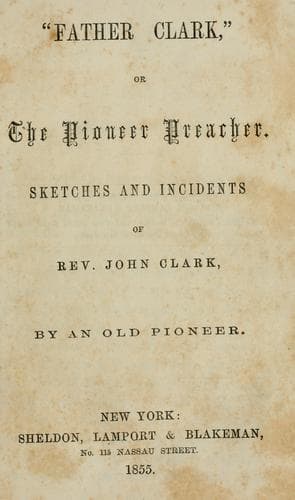
"Father Clark," or The Pioneer PreacherPeck, John Mason
History
"Father Clark," or The Pioneer Preacher
Peck, John Mason
Clark, John, 1758-1833; Methodist Episcopal Church -- Clergy
During the period of youth, Clark was singularly amiable, moral,
kind-hearted and generous. He lost no time by idleness, had no
inclination to the vain amusements and frivolities of youth, and
sustained an estimable character for personal sobriety, good order
and morality. The unfortunate example of his father excited pity and
disgust; the devoutly religious character of his mother confirmed and
deepened the impressions of childhood. There was more of puritanical
strictness, form, and rigid orthodoxy, than active piety and the
outpourings of the religious emotions, in the Church of Scotland at
that period, and young Clark neither felt nor manifested those feelings
of ardent love to the Redeemer, and comfortings of the Holy Spirit,
that had been awakened in his young heart at the early age of eight
years, or which distinctly marked his religious character in after life.
Our youthful friend became an enthusiastic lover of liberty and of the
rights of man, at an early age, and which continued the ruling passion
during life. In the period of old age he records these facts.
“When I was very young, I deeply imbibed the spirit of war--owing
chiefly from hearing much of the success that attended the British
arms by land and sea, during the war in Canada. When in the
seventeenth year of my age, the Revolutionary war between Great
Britain and her Colonies commenced, and I soon found myself as much
opposed to the spirit of war as I was formerly in favor of it.”
This feeling remained after he became connected with the navy, and
caused him to desert the service, into which he had been forced by the
press-gang. And yet, as if to show us that a young man so amiable,
kind-hearted, and philanthropic as Clark, was far from perfection,
or even consistency of character, he engaged in the business of
privateering; a business now regarded by civilized nations as barbarous
and immoral.
CHAPTER II.
Clark becomes a Sailor.--Privateering.--His Subsequent
Reflections.--Last Visit to his Parents.--Sails as Mate to the
West Indies.--Pressed on Board the Man-of-War Tobago.--A Fight,
and Death of the Gunner.--Admiral Rodney.--Escapes from the
Tobago.--Visits his Brother.--Ships for England.--Taken by
the Spaniards.--Obtains his Freedom, and again Pressed on Board
the Narcissus.--Deserts a Second Time, and Swims Ashore on James’
Island, off Charleston, at Great Risk.
Public-domain text, read in full here on John Shaqi.
Reviews
Reviews
No reviews yet
Be the first to share your thoughts on this work.
Join the Discussion
Join the discussion
Sign in to leave a comment or review.
Sign InorCreate an account