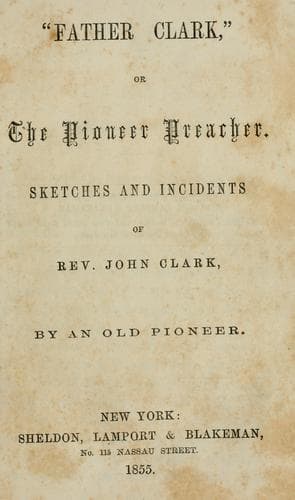
"Father Clark," or The Pioneer PreacherPeck, John Mason
History
"Father Clark," or The Pioneer Preacher
Peck, John Mason
Clark, John, 1758-1833; Methodist Episcopal Church -- Clergy
The propensity of young Clark to a sea-faring life remained ungratified
until he was twenty years old. Much as he desired to see the world, and
repulsive as was the conduct of his father to his sensitive feelings,
John had no wish to run away clandestinely--to leave his affectionate
mother and sisters, or to reject the monitions of his conscience. He
patiently waited until the proper time should come; until he attained
the period of manhood, and could go with his parent’s blessing. And
then, even filial affection and true philanthropy, prevailed over a
churlish and selfish temper, and prompted him to regard the welfare of
his parents to his own personal interests.
It was in the summer of 1778, in the twentieth year of his age, that
John Clark embraced the opportunity of carrying into effect his darling
purpose of life, by engaging in the transport service. But to this he
was induced by higher motives than a selfish indulgence. His education
had been completed, and he had spent some time copying in the town
and county office of Inverness. To the close of his life he wrote in
a style of uncommon neatness and accuracy. This employment furnished
no income beyond ordinary expenses. The extravagance and dissipation
of his father, had nearly reduced the family to want. The riches
realized from their uncle Daniel’s estate, gained doubtless by fraud
and extortion, from the Indians of Georgia, had made themselves wings
and flown away.[2] The farm in Petty was left, but the income was
barely sufficient for their support, and nothing can prosper under the
management of an intemperate husband and father; and John piously and
resolutely resolved to do his best in the business of his choice, to
keep their heads above water.
He embarked in the transport service, at low wages.[3] Finding, on his
return, that his father’s extravagance was fast wasting away their
means of support, and hoping to obtain in a more speedy way the means
of relief, he went to Greenock and entered on board a privateer;
and the voyage was so successful in capturing two valuable merchant
vessels, that in less than a year he returned home with his wages and
share of the prize money, amounting to more than $200. Of that business
then regarded lawful and honorable in war, fifty years after, he writes
thus:
“This unchristian, inhuman, and almost piratical practice, was
never permitted in Scotland before that war. But my moral feelings
by this time began to be impaired, for my situation in life
deprived me of the company of the godly, and ‘evil communications
corrupt good manners.’[4] Although my conscience recoiled at doing
that which I was not willing others should do to me, yet I made
necessity my excuse, and pleaded the example of those who I then
thought knew more and were better than I was.”
Public-domain text, read in full here on John Shaqi.
Reviews
Reviews
No reviews yet
Be the first to share your thoughts on this work.
Join the Discussion
Join the discussion
Sign in to leave a comment or review.
Sign InorCreate an account