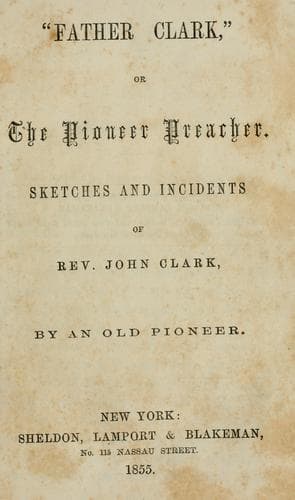
"Father Clark," or The Pioneer PreacherPeck, John Mason
History
"Father Clark," or The Pioneer Preacher
Peck, John Mason
Clark, John, 1758-1833; Methodist Episcopal Church -- Clergy
The Regular Baptists in the Middle States originated from Wales; and in
several instances, churches already organized came over as colonists.
They settled mostly in New Jersey, Pennsylvania, and a corner of
Delaware and Maryland, towards the close of the seventeenth, and during
the eighteenth centuries, previous to the American revolution. At a
later period, the descendants of these early colonists removed south,
and formed the nucleus of churches in Virginia, and even in North
and South Carolina. The doctrines they taught, as they interpreted
the Scriptures, may be found in a little book commonly called the
“Philadelphia Confession of Faith,” because it was revised, adopted and
published by the Philadelphia Baptist Association in 1742.[32]
All true Baptists take the word of God, the inspired writings, as their
_sole rule_ of faith and practice. There were some diversities among
the Regular Baptists about certain doctrinal principles, as there
were also among the Separates. These diversities in some localities
prevented for a time cordial union, correspondence and coöperation,
chiefly because they misunderstood each other in their modes of
explanation. The differences in all the parties consisted in the way
each party reasoned on abstruse points. Each put that construction on
the language employed by the other that accorded with the peculiar
technical meaning he attached to the same words.
The “Separate Baptists” originated in Virginia and the Carolinas from
two leading ministers who, with their adherents, came from New England
about 1754. The leaders were Shubael Stearns and Daniel Marshall. These
men were Congregationalists, and belonged to a party that _separated_
from the old Puritan Congregationalists of New England; being less
Calvinistic in doctrine, and believing that such men as had grace,
gifts, and a “call of God” to the ministry, ought to preach the
Gospel if they had no collegiate education. This party were at first
Pædobaptists; that is, they believed and practiced infant baptism on
the faith and the covenant relation of the parents; but gradually
they gave up this practice, and in the end most of the ministers and
members of this party joined the Baptist churches.
Public-domain text, read in full here on John Shaqi.
Reviews
Reviews
No reviews yet
Be the first to share your thoughts on this work.
Elsewhere in the archive
Join the Discussion
Join the discussion
Sign in to leave a comment or review.
Sign InorCreate an account