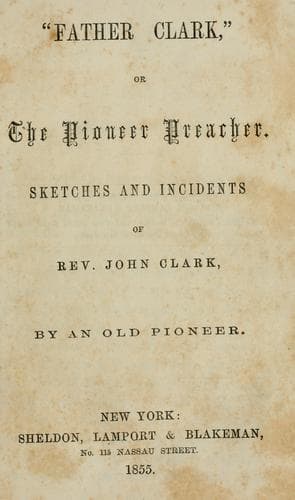
"Father Clark," or The Pioneer PreacherPeck, John Mason
History
"Father Clark," or The Pioneer Preacher
Peck, John Mason
Clark, John, 1758-1833; Methodist Episcopal Church -- Clergy
Elder Stearns became a Baptist, and was ordained in Connecticut, but
led by impressions of mind, with several relatives and brethren,
removed south to Virginia, where Mr. Marshall joined him; and then
to Guilford county, N. C., where they constituted a church. While in
New England, these Separates had acquired a warm, pathetic style of
preaching, and exhibited intense feelings. They had a sing-song tone,
and their manner of preaching got hold of the hearts of the people and
produced much preternatural excitement. Their hearers shed tears, cried
out under great distress, and shouted in ecstacy on a revulsion of
feelings. In a few months they had baptized about six hundred converts.
Several warm-hearted, zealous preachers were raised up; one of the most
gifted was James Read, who was very successful in Virginia.
At the first no distinctive names were attached to these parties, but
the Separates from New England kept that name, which provoked the other
party to call themselves “Regular Baptists.” This name originated
with Elder David Thomas, of Virginia, who possessed great influence,
and was regarded by his brethren as a leader. Occasionally, and
especially in seasons of revival, the ministers would coöperate, but
the parties remained distinct, with the usual amount of shyness and
non-intercourse, common in such divisions.
From the position we now occupy, it is easy to perceive that both
parties had mistaken views, and employed inappropriate language to
express gospel truth. The things for which they were the most tenacious
were their opinions, or speculations; and many points were discussed in
their discourses that were of no advantage to truth. On the disputed
topics both parties “darkened council by words without knowledge.”[33]
An extensive revival of religion in Virginia brought about a union
between the Regular and Separate Baptists in 1787; a religious platform
expressing their views in common was adopted, and the parties laid
aside their distinctive names and took that of UNITED BAPTISTS.
The emigration of Baptists from Virginia to Kentucky commenced near the
close of the revolutionary war, and the old lines of distinction were
kept up there for about sixteen years longer. South of the Kentucky
river, a majority of the churches were Separate Baptists, at the period
of the visit of Father Clark.[34]
Public-domain text, read in full here on John Shaqi.
Reviews
Reviews
No reviews yet
Be the first to share your thoughts on this work.
Elsewhere in the archive
Join the Discussion
Join the discussion
Sign in to leave a comment or review.
Sign InorCreate an account