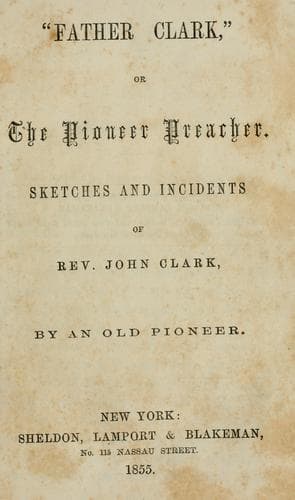
"Father Clark," or The Pioneer PreacherPeck, John Mason
History
"Father Clark," or The Pioneer Preacher
Peck, John Mason
Clark, John, 1758-1833; Methodist Episcopal Church -- Clergy
Journey to Illinois.--Story of the Gilham family, captured by
Indians.--Hard fare.--Mr. Gilham attempts to recover them.--
Indian War.--Peace made.--The Family Redeemed.--Removes to
Illinois with Mr. Clark.--Navigation of Western Rivers.--Story
of Fort Massac.--Terrible sickness.--Settlement of New Design.
--An ungodly race.--First Preacher in Illinois.--A Stranger
in meeting.--First Baptisms.--Other Preachers.--First Church
Formed.--Manners and customs of the French.--Indian War.--
Stations or Forts Described.--PIONEER BOOKS projected.
And now we find the pioneer preacher trudging along the obscure pathway
that guided him down the country in a western direction, towards the
Green river district. He made appointments and preached in all the
principal settlements as he journeyed, and was treated kindly and
hospitably by all classes of people. It was in the Green river country
he became acquainted with James Gilham, who was then preparing to
remove his family and settle in the Illinois country, and wanted three
or four able bodied men to accompany him, and work the boat down the
Ohio and up the Mississippi. Mr. Clark had started from Lincoln County
with the intention of passing through the wilderness on foot, but he
had now a good opportunity of proceeding in a keel boat, or French
pirogue, by water. They fitted out at the Red-banks, on the Ohio.
While pursuing their journey of several hundred miles, Mr. Clark, in
accordance with a long cherished wish, had a fine opportunity to learn
much of Indian character and habits from this family. Mrs. Gilham and
three children had been redeemed from a long and distressing captivity
but two years before, and the story of her sufferings, privations, and
wonderful preservation, as told to Mr. Clark, while sitting around
their camp fire at night, deserves a place in our narrative.
Mr. James Gilham was a native of South Carolina, where he married his
wife Ann, and commenced the battle of life as a frontier farmer. He
removed his young family to Kentucky, and pitched his station in the
western frontier settlements of that district. There he purchased a
claim to a tract of land, and cleared a farm, cheered with the hopeful
anticipations of a peaceful and happy life; but, like many others, he
and his wife were doomed to disappointment. They had three sons and
one daughter living, between the ages of four and twelve.
Public-domain text, read in full here on John Shaqi.
Reviews
Reviews
No reviews yet
Be the first to share your thoughts on this work.
Elsewhere in the archive
Join the Discussion
Join the discussion
Sign in to leave a comment or review.
Sign InorCreate an account