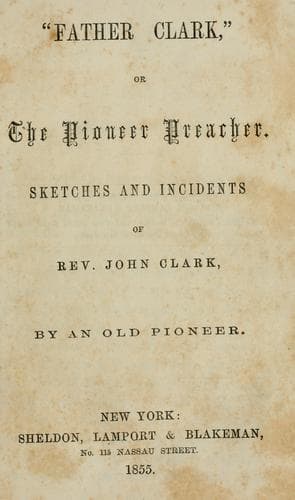
"Father Clark," or The Pioneer PreacherPeck, John Mason
History
"Father Clark," or The Pioneer Preacher
Peck, John Mason
Clark, John, 1758-1833; Methodist Episcopal Church -- Clergy
It was in the month of June, 1790, that he was ploughing in his corn
field, some distance from his house, from which he was hidden by a
skirt of timber, while his eldest son Isaac was clearing the hills from
weeds with the hoe. At the same time several “braves” of the Kickapoo
tribe of Indians, from the Illinois country, were lurking in the woods
near the house, where Mrs. Gilliam, the two little boys, Samuel and
Clement, and the daughter, were sheltered, wholly unsuspicious of such
visitors. The Indians, finding the door open, rushed in; some seized
the woman and gagged her, to prevent her giving the alarm; others
seized the children, who could make no resistance. Mrs. Gilham was so
alarmed that she lost her senses, and could not recollect any thing
distinctly, until aroused by the voice of Samuel, “Mamma, we’re all
prisoners.” This excited her feelings, and she looked around to find
out whether the other children were all alive. Indians never walk
abreast, as white people do. One leads off on the trail, and the others
follow in single file, and are sometimes half a mile apart. One stout,
bold warrior, went forward as a guide, and another kept many yards
behind as a spy, watching cautiously to see if they were followed. They
kept in the thick forest, out of the way of all the settlements, lest
they should be discovered.
Mrs. Gilham and the children were in great distress. They were hurried
forward by their savage masters, whose fierce looks and threatening
gestures alarmed them exceedingly. The Indians had ripped open their
beds, turned out the feathers, and converted the ticking into sacks,
which they had filled with such articles of clothing as they could
conveniently carry from the cabin, but were in too much haste to be off
with their captives, to lay in provisions. They were used to periods
of starvation, and could go three or four days without food, but the
mother and her little ones suffered to an extent beyond the conception
of our readers. But human nature can endure much in extreme cases. The
feet of the children soon became sore and torn with briers; and the
poor woman tore her clothes to obtain rags to wrap around their feet.
The savages, as they thought, treated them kindly,--just as they would
have done to their own children,--and Mrs. Gilham and the children had
been familiar with the privations of frontier life, but they always
had enough of plain, coarse food to eat; now they were starving. The
Indians had with them a morsel of jerked venison, which they gave the
children, but for themselves and the suffering mother there was not a
particle of food to eat. One day they encamped in an obscure place,
and sent out two of their best hunters, who crept stealthily through
the thick brush and cane, and returned towards night with one poor
raccoon. Mrs. Gilham afterwards told her friends that the sight of that
half-starved ’coon was more gratification to her at that time than any
amount of wealth could have afforded.
Public-domain text, read in full here on John Shaqi.
Reviews
Reviews
No reviews yet
Be the first to share your thoughts on this work.
Elsewhere in the archive
Join the Discussion
Join the discussion
Sign in to leave a comment or review.
Sign InorCreate an account