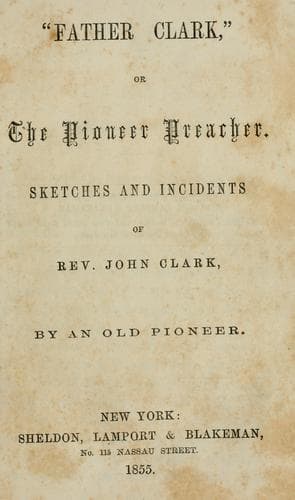
"Father Clark," or The Pioneer PreacherPeck, John Mason
History
"Father Clark," or The Pioneer Preacher
Peck, John Mason
Clark, John, 1758-1833; Methodist Episcopal Church -- Clergy
At that period the white population of the Illinois country, numbered
about 2,700, of which about two-thirds were of French descent, spoke
that language, and followed the customs of the Canadians, from whence
most of their forefathers originated. They were a contented race of
people, patient under hardships, without ambition, and ignorant of
the prolific resources of the country. They never troubled themselves
with political matters, engaged in no schemes of aggrandizement, and
showed no inclination for political domination. They were a frank,
open-hearted, joyous people, and careless about the acquisition
of property. Their houses were small, built of logs set upright,
like palisades, with the spaces filled in, plastered, and neatly
white-washed inside and out. They cultivated fruits and flowers, and
in this respect showed taste and refinement beyond the Americans. In
religion they were nominally Roman Catholics; in the morning of the
Sabbath they attended mass, and in the afternoon visited, played the
violin, danced, or engaged in other recreations and ruder sports out of
doors.
Another pioneer who was an exhorter in the Methodist connection, and
came to the country in 1796, was the late Rev. Hosea Riggs, who at
first settled in the American bottom. Mr. Riggs was born in Western
Pennsylvania in 1760, became a soldier in the revolutionary war; and
when twenty-two years of age, he enlisted in the army of Jesus Christ
and joined the Methodist Episcopal church, became an exhorter, and
proved himself a diligent and faithful soldier of the cross. When
he arrived in the Illinois country with his family he found Capt.
Joseph Ogle and family, Peter Casterline and family, and William
Murray from Ireland, the remains of the class formed by Mr. Lillard.
These he re-organized into a class at Captain Ogle’s house, and at a
subsequent period formed another class of immigrant Methodists, in
Goshen settlement. This was in Madison county, between Edwardsville and
the American bottom. Mr. Riggs, though then only a licensed exhorter,
attended these Methodist classes, and made appointments for meetings
for six years. He attended the “Western Conference” in Kentucky, 1803,
raised a Macedonian cry, and the Conference sent Rev. Benjamin Young
as a missionary, who was the first preacher of the Methodist Episcopal
church who traveled the circuit in Illinois. Mr. Riggs was tenacious
for the Methodist government and discipline, and hence did not so
readily coöperate with Father Clark. He was a good man, a faithful
preacher, lived a Christian life, and died a Christian death, in St.
Clair county, in 1841, at the age of eighty-one years.
We have now brought up the religious history of Illinois to the period
of the arrival of Mr. Clark. But to give our young readers a fuller
picture of frontier life, and of the people with whom he lived and
labored, and their deprivations, we must again look back on their
condition for a few years past.
Public-domain text, read in full here on John Shaqi.
Reviews
Reviews
No reviews yet
Be the first to share your thoughts on this work.
Elsewhere in the archive
Join the Discussion
Join the discussion
Sign in to leave a comment or review.
Sign InorCreate an account