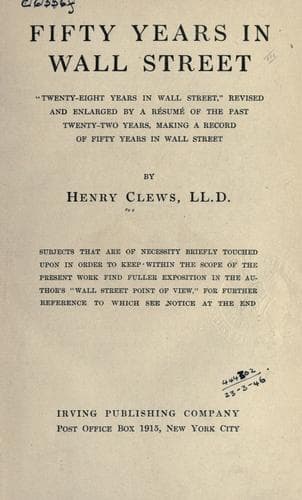
Business; Capitalists and financiers -- United States; Speculation; Wall Street (New York, N.Y.)
The Commodore arose and shook off his lethargy, as a lion may be
supposed to shake the dew from his mane prior to his preparation for a
spring upon an unfortunate foe.
The Commodore hastened down to Wall Street and instructed his brokers to
take all the sellers’ options offered in Hudson. Cash stock was then
taken as quickly as possible until the market was bare. A brief
calculation showed that the buyers had secured either as cash or
contract stock all the Hudson stock in existence with the exception of a
small number of shares which were not expected to come upon the market.
The prolific brain of the Commodore then invented a new move in the
game. A number of leading “bear” houses were requested to “turn” Hudson,
which means to buy it for cash from the cornering party and sell it back
to them on buyers’ options for periods varying from ten to thirty days.
This able ruse was intended to impress the bears with the idea that the
cornering party was weak. It seemed as if they were short of cash. So
the leading bears grasped at the good chance, as they imagined, of
turning several thousand shares, and instantly threw the cash stock on
the market. It was privately picked up by the brokers of the great
“cornerer.”
Everything having thus far progressed in favor of the ruse the trap was
sprung upon the unsuspecting party. The sellers’ options began to
mature, and there was no Hudson to be obtained.
The “corner” was complete, and the stock rose to 180. It had been 112 a
few mornings before, when the Commodore was basking in the sun, and
found that the bears were taking advantage of his absence. The loss on a
hundred shares was $6,800.
There were about 50,000 shares contracted for to be delivered at this
rate of profit by the “cornerers.” It will thus be seen that they were
well fixed.
The bears were in terrible anguish.
But the worst part of the deal for these poor animals had yet to come.
The bears who had turned the stock were notified that they must stand
and deliver. They complained bitterly of the ingratitude of the bulls,
whom they had only sought to oblige, by turning the stock. The bulls
were implacable, however, and demanded their property. They proposed a
compromise which was most exacting. They were willing to lend stock at
five per cent. per day. Some of the bears paid this, thinking the
“corner” would be of short duration, but it continued for over two
weeks, and, after paying five per cent. a day for several days, these
poor victims bought the stock at the high rate and settled.
This double move in turning the stock was the ablest trick that had ever
been accomplished in cornering. It made Vanderbilt king of strategists
in that line.
But the best part of the stratagem was that wherein the bulls saved
themselves from being saddled with the whole stock, and made immense
profits out of the deal.
Public-domain text, read in full here on John Shaqi.
Reviews
Reviews
No reviews yet
Be the first to share your thoughts on this work.
Elsewhere in the archive
Join the Discussion
Join the discussion
Sign in to leave a comment or review.
Sign InorCreate an account