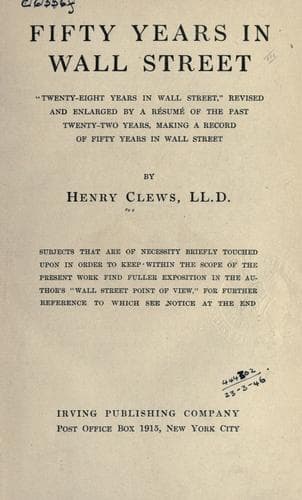
Business; Capitalists and financiers -- United States; Speculation; Wall Street (New York, N.Y.)
From the time that Abraham Lincoln was elected to the Presidency of the
United States, in November, 1860, the South began to prepare for
secession from the North, peaceably if the North consented, but by war
if it resisted. It was bent on this course because it foresaw in a
Republican administration at Washington its practical loss of control of
Congress and the spoils of office—in fact, of the Government itself—that
it had so long enjoyed under Democratic administrations. James
Buchanan’s term as President having expired on March 4, 1861, Abraham
Lincoln was then inaugurated as his successor. It angered the South to
see a Republican succeed a Democrat in the White House, and it
precipitated the tremendous conflict that followed, by seizing Fort
Moultrie, in Charleston Harbor, and firing on Fort Sumter. Fort
Moultrie’s guns awoke the North to action, and made it a determined unit
in defense of the flag that had been fired upon, and its cry was, “The
Union must and shall be preserved!”
As this was the most eventful and critical period in our national
history since 1776, and so many know it only by what they have read of
it, I will give a general idea of its salient features bearing upon the
Government finances and the war loans.
When, after the bombardment of Fort Sumter by Fort Moultrie, on April
14, 1861, Major Robert Anderson, the Union commander, accepted, under
the stern necessities of the situation, General Beauregard’s terms of
evacuation, the die was cast.
The North picked up the gauntlet of war with patriotic enthusiasm, and
the great conflict had begun. But when our troops marched out of that
dismantled stronghold of the Union, with drums beating and colors
flying, it is safe to say that few or none, either in the North or the
South, foresaw the long and mighty struggle that would, for four
eventful years, follow the bombardment of Fort Sumter, during which gold
would become demonetized before the end of the year. It did so on
December 30, 1861, and in the darkest days of the conflict commanded a
premium as high as one hundred and eighty-five per cent. over United
States legal tender notes, making these worth only 54 1/20 cents in
gold, while United States bonds were selling for about 60 cents on the
dollar in gold.
When the New York Clearing House agreed, on the date named, to suspend
specie payments, the example was at once followed by all the banks in
the country, and gold immediately began to command a small premium. None
supposed then that the suspension would continue for eighteen years.
Public-domain text, read in full here on John Shaqi.
Reviews
Reviews
No reviews yet
Be the first to share your thoughts on this work.
Join the Discussion
Join the discussion
Sign in to leave a comment or review.
Sign InorCreate an account