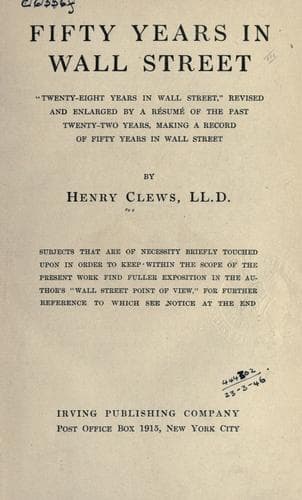
Business; Capitalists and financiers -- United States; Speculation; Wall Street (New York, N.Y.)
In England, during the long suspension from 1797 to 1821—through the
Napoleonic wars—the premium on gold never rose above forty-one per
cent., and that was in 1814, the year before the end of hostilities.
This was owing to the policy of William Pitt and his successors in the
management of the British finances. They raised all the money needed for
war purposes by taxation and loans, thus restricting the paper money
issues, so as to prevent currency inflation, whereas we pursued the
opposite course.
When Fort Sumter was fired upon, my firm—Livermore, Clews & Co.—was
already prominent in Wall Street, and I immediately began to devise ways
and means to help the Government to raise the money that I saw would be
necessary to prosecute the war for the Union which this bombardment made
inevitable. Fort Moultrie’s guns had united the North in a call to arms,
and men by tens of thousands left the farm, the loom, the office, and
the store, from Maine to Indiana, to join the Union army.
Money, therefore, was needed by the United States Government, and very
large amounts of it, to equip troops and purchase munitions of war.
As James Buchanan was then President, and, like a long line of his
predecessors, a Democrat, he had several Southerners in his Cabinet.
These promptly resigned their places and went South, including the
Secretary of the Treasury, Howell Cobb, who left with surprising
suddenness, and the office was filled for a brief period by General John
A. Dix, as acting Secretary.
But before leaving, Howell Cobb had offered and sold to Wall Street
bankers $20,000,000 of United States five per cent. bonds at 105,
authorized, of course, by an old law. Owing, however, to the heavy
decline in securities, and general depression following the outbreak of
the war, only about one-quarter of these bonds were taken and paid for
by those who had subscribed for them; and nothing was done by the
Government to enforce the completion of the purchase by those who had
defaulted under the severe stress of the times.
Their default was a serious matter for the Government at that time, as
it left the funds in the Treasury in a very depleted condition, and
interest payments on the public debt were about to fall due, which it
had no money in its vaults to provide for. At this crisis John J. Cisco,
the United States Sub-treasurer in New York, was instructed, from
Washington, to call a meeting of the principal Wall Street bankers at
the Sub-treasury, and after stating the situation to them, to ask for an
emergency loan on one-year United States notes, and let them fix the
rate of interest themselves to correspond with the state of the money
market.
Public-domain text, read in full here on John Shaqi.
Reviews
Reviews
No reviews yet
Be the first to share your thoughts on this work.
Join the Discussion
Join the discussion
Sign in to leave a comment or review.
Sign InorCreate an account