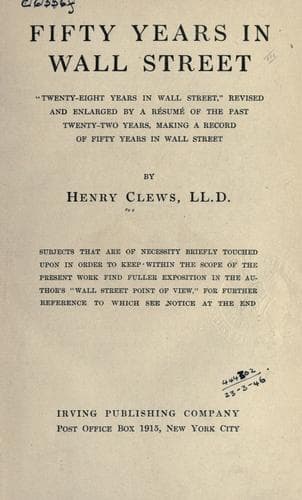
Business; Capitalists and financiers -- United States; Speculation; Wall Street (New York, N.Y.)
From that time until the panic of 1873 their amount remained at
$356,000,000. In the interval Mr. Boutwell had succeeded Mr. McCulloch,
and Mr. Richardson had succeeded Mr. Boutwell as Secretary. Mr.
Richardson, under diminished customs and revenue receipts, and the
stress of the panic, restored to circulation $26,000,000 of the
$44,000,000 of legal tender notes that had been withdrawn by Mr.
McCulloch, whereupon Congress, on June 22, 1874, provided that the
greenbacks in circulation should remain fixed at the then existing total
of $382,000,000.
The same law which thus legalized the reissue of the $26,000,000 of
legal tender notes by Secretary Boutwell abolished the National Bank
reserve, previously required to be kept on bank-note circulation, and
for this substituted the provision that the banks were to deposit five
per cent. in legal tender notes of the amount of their own note issues
with the United States Treasurer at Washington for the redemption of
their notes.
This law is still in force, and the establishment of the Redemption
Bureau at Washington has resulted, ever since, in daily receipts by it
of mutilated bank notes to be replaced by new notes, in addition to the
ebb and flow caused by banks increasing or reducing their circulation.
The five per cent. in legal tender deposited is counted by them as part
of their legal reserve. But the necessity of sending the notes to
Washington, and of receiving them therefrom, involves trouble and loss
of time to the banks, and also prevents the banks from contracting their
circulation when the demand for it is light and increasing it when
heavy, as freely and promptly as they would if every Sub-treasury was
made a redemption point for National Banks. Congress ought therefore to
authorize the equipment of the Sub-treasuries with redemption bureaus
for the banks in their respective districts, in order to facilitate this
ebb and flow of bank-note issues, and so increase the much needed
elasticity of the currency.
In addition to United States legal tender notes, large amounts of
interest-bearing legal tender notes were issued during the war. On
September 1, 1865, when the currency, like the whole National debt,
reached its greatest amount of inflation, the noninterest-bearing legal
tender notes and fractional currency stood at $459,505,311, the three
years six per cent. compound interest legal tender notes at more than
$217,000,000, and the one and two years five per cent. legal tender
notes at nearly $34,000,000, the whole aggregating $685,236,269 issued
by the Treasury.
Public-domain text, read in full here on John Shaqi.
Reviews
Reviews
No reviews yet
Be the first to share your thoughts on this work.
Join the Discussion
Join the discussion
Sign in to leave a comment or review.
Sign InorCreate an account