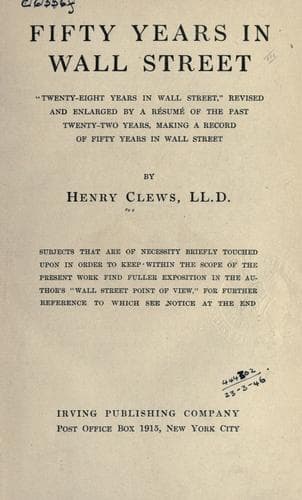
Business; Capitalists and financiers -- United States; Speculation; Wall Street (New York, N.Y.)
There were also outstanding $107,000,000 of temporary loan certificates.
These, being payable after ten days’ notice, were treated as greenbacks
by the banks, and counted as part of their lawful money reserve, while
the remainder circulated as currency, and so practically increased the
volume of paper money. At the same time the new National Bank law had
put in circulation $170,000,000 of National Bank notes; and more than
$70,000,000 of State Bank notes were still circulating. The last named
were, however, soon taxed out of existence by Congress. The grand total
of the issues enumerated was ten hundred and sixty-seven millions of
paper money in circulation. Nor was this all, for there were then
outstanding $85,000,000 of one-year certificates of indebtedness; and
the $830,000,000 of 7-30 notes, called 7-30s, outstanding were
extensively used as money, and so tended to increase the inflation of
the currency and prices.
It will be seen therefore that the inflation of the currency was really
much larger than it appeared to be by the Public Debt statements at that
time. But so rapid was the contraction during the eight years following,
through the maturity and cancellation of interest-bearing notes and
certificates, that it is safe to say we had from sixty to seventy-five
per cent. less paper, used as money, in circulation when the panic of
1873 commenced than we had in September, 1865, and to this enormous
contraction of our medium of exchange that disastrous panic, the worst
this country ever had, was largely due. It was, I repeat, the worst in
its effects that this country ever experienced, not excepting the panics
of 1837 and 1857, and was aggravated by the Franco-German War, that
practically shut American securities out of the European markets, which
had previously taken them freely. This was a severe blow to the American
bankers who had undertaken to finance the railways then in process of
construction in different parts of the country, and who had relied upon
finding both home and foreign markets for the sale of the bonds issued
against the completed mileage of these railways, and it led to much
embarrassment and a number of failures. The depression following this
panic of 1873—in which Jay Cooke & Co. failed owing to their having
undertaken to finance the Northern Pacific—was prolonged, and prosperity
did not really return to us as a Nation till after the resumption of
specie payments in 1879. Meanwhile, nearly all the uncompleted railways
in the country had been reorganized through foreclosures that wiped out
hundreds of millions.
Public-domain text, read in full here on John Shaqi.
Reviews
Reviews
No reviews yet
Be the first to share your thoughts on this work.
Join the Discussion
Join the discussion
Sign in to leave a comment or review.
Sign InorCreate an account