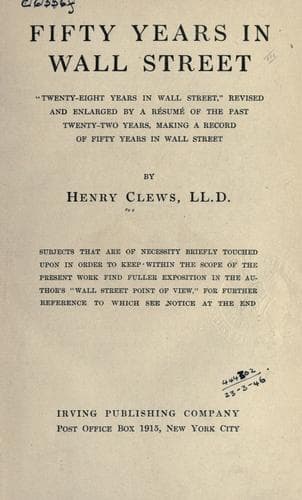
Business; Capitalists and financiers -- United States; Speculation; Wall Street (New York, N.Y.)
Till within a short time of its final termination the duration of the
war was a matter of much uncertainty, and its ultimate result had long
been the subject of doubt and gloomy forebodings by many who failed to
see that the superior money power and resources of the North were sure
to conquer and crown the Union with victory in the end. Our currency,
greatly inflated though it was, remained good throughout the trying
ordeal, whereas that of the Confederate States became utterly
discredited and worthless, thus repeating the history of the French
_assignats_.
A new era opened in our history with the ending of the war, and our
currency, which, of course, had previously no circulation in the South,
began to circulate there. This, of itself, was equivalent to extensive
contraction. The currency of one section had now to supply the currency
needs of both sections, and for a long time the drain of money from the
North to the South was felt in the money market.
The country was somewhat like a sick man accustomed to and dependent on
stimulants, to withdraw which suddenly would have been perilous. Many in
Congress recognized this danger, for it was a noticeable feature of the
debates on the subject that not a few of those who had been strongly
opposed to our excessive issues of paper money during the war, and
warned the country against them, were among those who opposed violent
contraction as being a remedy worse than the disease. The radical
contractionists, however, failed to see, or refused to acknowledge, that
the arguments which would have applied to the rising tide of the
currency while the war continued, and there was danger of indefinite
further inflation, did not apply with equal force to the altered
condition of affairs.
Although schemes of radical contraction were rejected, even the moderate
measure of contraction that was adopted proved too severe to be endured
without much complaining from business interests, so hard and painful is
the process of contraction, whereas that of inflation is always pleasant
and easy.
In later years I became very well acquainted with General Grant, and
toward the end of his first term of the Presidency, when a good deal of
opposition was manifested to his renomination by the press, including
the New York _Evening Post_, I made strenuous efforts to secure his
renomination. To that end I organized a public meeting at the Cooper
Institute, and induced William E. Dodge to act as Chairman. It was a
great popular success, and Grant’s renomination was unanimously
advocated with immense enthusiasm. The _Evening Post_ then said that
after such an overwhelming demonstration it was evident that public
sentiment was on the side of Grant, and that it was useless to oppose
his renomination. He was accordingly renominated by the Republican Party
and triumphantly reëlected. His second term as President began on March
4, 1873, and he retired from the Presidency four years later.
Public-domain text, read in full here on John Shaqi.
Reviews
Reviews
No reviews yet
Be the first to share your thoughts on this work.
Join the Discussion
Join the discussion
Sign in to leave a comment or review.
Sign InorCreate an account