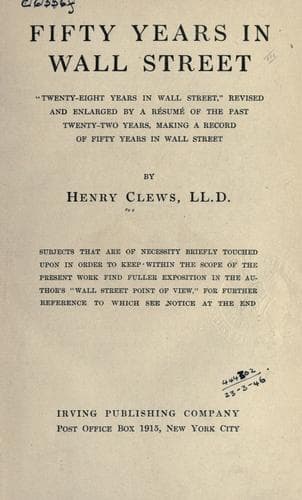
Business; Capitalists and financiers -- United States; Speculation; Wall Street (New York, N.Y.)
Our National debt, which had increased from $64,000,000 on June 30,
1860, and $88,409,387 on June 30, 1861, to $2,845,907,626 on September
1, 1865, had then been very largely reduced, for it was only
$2,140,695,365 on September 1, 1873. The debt and the currency had gone
up and down together under the influence of a common cause. Not till
specie payments were resumed by the Government and the banks did gold
cease to command a premium. With this the Gold Room became a thing of
the past.
The great activity and the enormous sales of the Government agents may
be inferred from the maximum amounts I have quoted, of the 7-30 notes,
and the 5-20 and 10-40 bonds outstanding five months after Lee
surrendered to Grant at Appomattox on April 9, 1865.
The total debt on which interest was payable in coin then amounted to
$1,116,658,100, while that bearing interest in lawful money was
$1,874,478,100, the first calling for $65,001,570 in gold annually, and
the other for $72,527,646 of greenback currency.
That great event—Lee’s surrender to Grant—that ended the war, was the
fitting prelude to General Grant’s election to the Presidency. It made
it certain that no other Republican candidate for the office of
President of the United States would have any chance of success at the
next general election, and, of course, no Democratic candidate could be
elected. Grant became our great National hero, and the country glorified
him for his splendid war record.
But soon after the memorable historical scene at Appomattox, while the
country was rejoicing over the advent of peace, with the Union restored,
there came that terrible tragedy at Ford’s Theater in Washington, when
President Lincoln, on April 14, 1865, was assassinated by John Wilkes
Booth, and on the following day Vice President Andrew Johnson was sworn
in as President.
Then, indeed, the Nation was plunged into mourning, and mourning emblems
from ocean to ocean testified to the National grief.
I will not dwell on the stormy career of Andrew Johnson as President,
and the impeachment proceedings against him, that for a long time made
both branches of Congress seething cauldrons of excitement. But it was a
happy relief to the country when his term expired and General Grant
succeeded to the Presidency on March 4, 1869, with Schuyler Colfax as
Vice President. The Democratic candidates who had run against General
Grant in the campaign in which he was elected in November, 1868, were
Horatio Seymour and General Francis P. Blair, Jr. But the popularity of
Grant was so overwhelming that his election was a foregone conclusion.
Public-domain text, read in full here on John Shaqi.
Reviews
Reviews
No reviews yet
Be the first to share your thoughts on this work.
Join the Discussion
Join the discussion
Sign in to leave a comment or review.
Sign InorCreate an account