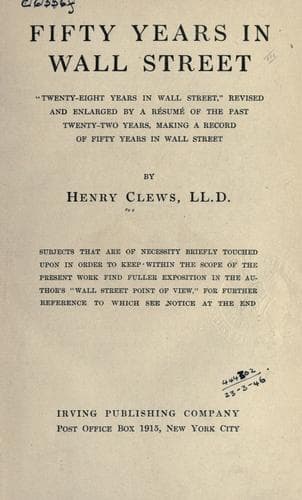
Business; Capitalists and financiers -- United States; Speculation; Wall Street (New York, N.Y.)
One of Jacob Little’s speculative ventures has been rendered
historically famous through the rule of limitation of sixty days for
option contracts. The necessity for this limit was brought about by one
of his celebrated attempts to manipulate the market. He was one of the
most prominent speculators in Erie in the early days of Drew’s
transactions with that property and its stocks. Mr. Little had been
selling large blocks of Erie on seller’s option, to run from six to
twelve months. This was in the early history of “corners,” before the
method of managing them scientifically had been fully developed and
while “blind pools” were yet in embryo.
[Illustration:
THIS MAP OF THE UNITED STATES OF AMERICA IS A PHOTOGRAPH TAKEN FROM
THE ORIGINAL PEN-AND-INK HAND DRAWING MADE BY HENRY CLEWS FIFTY-FIVE
YEARS AGO.
]
The leading members of the Erie Board formed a pool to “corner” Mr.
Little, and ran Erie shares up to a considerable height. They imagined
that he was in blissful ignorance of their purpose, and had everything
arranged for a _coup d’etat_ which was to reach its crisis at two
o’clock on a certain day, when Little was to be completely overwhelmed
and hopelessly ruined. An hour prior to the time appointed by the clique
for his disaster he walked into the Erie office, opened a bag filled
with convertible bonds, and requested an exchange of stock for the same.
He had purchased the bonds in London and had them safely locked up for
the emergency, which he promptly met on its arrival. He got the stock,
settled his contracts, broke the “corner,” and came out triumphantly.
The option limit of sixty days was afterwards adopted in order to
prevent similar triumphs in manipulation on the “short” side.
As will be illustrated more fully in subsequent chapters, Mr. Little’s
convertible bond trick was used with signal advantage by his speculative
successors in Erie, who practically demonstrated on several occasions
that there were millions in it.
Mr. Little was generous and liberal to a fault with his brother
speculators who had experienced misfortune. He used to say that he could
paper his private office with notes he had forgiven to the members of
the Board. He was also remarkable for his great memory. He could easily
remember all the operations he made in the course of a day without
making a note or a mistake.
Like Drew, he was careless in his attire, wearing a hat like that of a
farmer, and not a very prosperous one, but he had no compeer in his day
at calculating ahead in a speculative venture.
[Illustration:
JACOB LITTLE.
]
------------------------------------------------------------------------
CHAPTER II.
WALL STREET AS A CIVILIZER.
Public-domain text, read in full here on John Shaqi.
Reviews
Reviews
No reviews yet
Be the first to share your thoughts on this work.
Join the Discussion
Join the discussion
Sign in to leave a comment or review.
Sign InorCreate an account