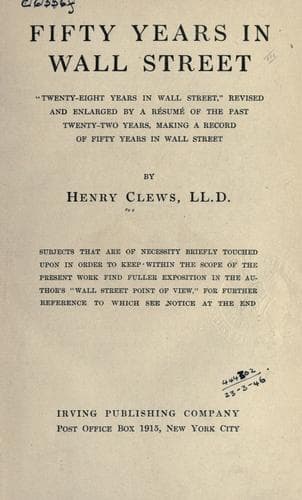
Business; Capitalists and financiers -- United States; Speculation; Wall Street (New York, N.Y.)
This was an old trick in his family, but it did not work effectually
this time. He said he had regarded the restoration of the Union
impossible from the first, and for that reason had deprecated the
continuance of the bloody contest, which could not lead to any other
result than separation. He authorized Mr. Lindsay to make this statement
to Lord Cowley, and to ascertain whether he would recommend the course
indicated to his Government.
It is very refreshing to reflect on the sensitive exhibition of feeling
displayed, in his ostensible attempt to stop the carnage and fratricidal
strife, by the man who planned and directed the wholesale assassinations
in connection with the sanguinary _Coup d’Etat_.
Mr. Lindsay reported back to the Emperor the substance of his interview
with Lord Cowley, who said that the English Government was not prepared
to act until further developments. It was about this time that Mr.
Seward was getting _in_ his fine diplomatic work with Earl Russell and
Palmerston, which helped materially to upset the calculations of the
Emperor.
Napoleon then requested Mr. Lindsay to see Palmerston, Russell, Derby
and Mr. Disraeli, and to gather their intentions. He desired Mr. Lindsay
to do all this of his own motion, and not as coming from him, and said
he did not wish to be embarrassed by the forms and delays of ordinary
diplomacy, because he felt the necessity of immediate action.
Lindsay again saw Earl Russell, as the accredited and special ambassador
of the Emperor, _viva voce_. The Earl informed him that he could not
receive any communications from a foreign power, except through the
regular diplomatic channel. He then sought an interview with Mr.
Disraeli, who was much more affable and communicative than the little
Lord who stood so punctiliously on ministerial ceremony.
Disraeli threw considerable light on the subject. After expressing a
deep interest in the affairs of the Confederacy, and saying that he
fully concurred in the views of the Emperor, he told Mr. Lindsay that he
had good reasons for believing that a secret understanding existed
between Earl Russell and Mr. Seward; that England, in the meantime,
would respect the Federal blockade and withhold recognition of the
South. “But if France should take the initiative,” said Mr. Disraeli in
conclusion, “any course she may adopt to put an end to the present state
of affairs will undoubtedly be supported by a large majority in
Parliament, and knowing this, Lord Russell will give a reluctant assent
to this, to avoid a change of ministry, which would otherwise certainly
follow.”
This shows that Disraeli saw very clearly through the duplicity of
English diplomacy, and that while England was profuse in her promises to
Mr. Seward, she was only waiting for the Emperor to act as pioneer in
order that she might have a safe opportunity as well as a plausible
pretext for armed intervention.
Public-domain text, read in full here on John Shaqi.
Reviews
Reviews
No reviews yet
Be the first to share your thoughts on this work.
Elsewhere in the archive
Join the Discussion
Join the discussion
Sign in to leave a comment or review.
Sign InorCreate an account