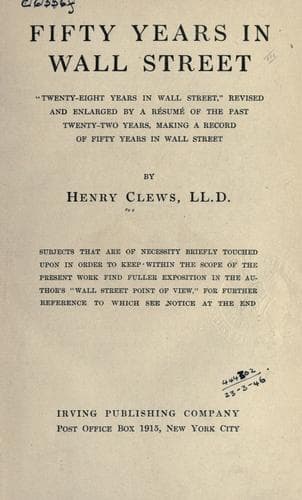
Business; Capitalists and financiers -- United States; Speculation; Wall Street (New York, N.Y.)
The Emperor complained that Earl Russell had divulged his views on
American affairs, as expressed through his ambassador, to Mr. Seward.
Lord Russell placed himself squarely on the “fence,” to be prepared for
any emergency. Finally, about the middle of April, the Emperor thought
it would be best that he himself should make a friendly appeal to the
Federal Government alone to open the ports, if England did not join him,
without further hesitation. He thought it would be necessary, however,
to accompany the appeal with a demonstration of force on the Southern
coasts; and if the appeal should be effective, to back it up by a
declaration of his purpose not to respect the blockade. He determined,
however, to wait a few days longer to see how England would act.
This resolution of the Emperor to make a friendly appeal to raise the
blockade was only a thin excuse to find a cause for quarrel with the
North, and it is very probable he would have acted on this determination
alone, but for an unexpected event which changed his projects, and the
apparent course of history.
About a week after this diplomatic conference, Commodores D. G.
Farragut, and D. D. Porter, with their able commanders Bailey and Bell,
had made the famous passage of forts Jackson and St. Philip, at the
mouth of the Mississippi, with the United States squadron, silenced the
Chalmette batteries and anchored in the harbor of New Orleans. After two
days’ parleying the city surrendered at discretion, or rather, the city
authorities passively and sullenly permitted Farragut, and afterwards
General Butler, to take possession of the city without shedding any
blood.
This great naval victory of Farragut’s squadron and its consequences
dampened the ardor of the Emperor. He saw the chances of backing up his
“friendly appeal” by a demonstration of force, were cut off, so far as
New Orleans and the forts of the Mississippi were concerned.
Yet, Napoleon did not totally relinquish the enterprise, on account of
this crushing defeat of the Confederacy. M. Billault, a prominent member
of Napoleon’s cabinet, after this event said to Slidell, “The cabinet,
with the probable exception of M. Thouvenel, are in favor of the South.
If New Orleans had not fallen, our recognition could not have been long
delayed, but if the Confederates should obtain successes in Virginia and
Tennessee, and hold the enemy at bay a month or two longer, we may see
an opportunity for intervention.”
Public-domain text, read in full here on John Shaqi.
Reviews
Reviews
No reviews yet
Be the first to share your thoughts on this work.
Elsewhere in the archive
Join the Discussion
Join the discussion
Sign in to leave a comment or review.
Sign InorCreate an account