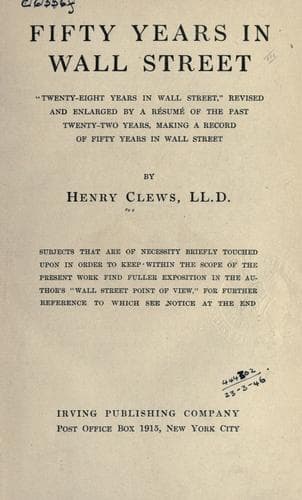
Business; Capitalists and financiers -- United States; Speculation; Wall Street (New York, N.Y.)
The Emperor’s intentions, however, were fully revealed in an autograph
letter to General Forey, which was written in July and in which his
grasping ambition stood out in the boldest relief. He wrote: “In the
present state of civilization of the world, the prosperity of America is
not a subject of indifference to Europe, for she nourishes our
manufactures and gives life to our commerce. We are interested in having
the Republic of the United States a powerful and prosperous power, but
we are not willing to have that Republic take possession of the entire
Gulf of Mexico, command from there the Antilles as well as South
America, and monopolize the distribution of the products of the New
World. To prevent this, a stable Government must be established in
Mexico, and we will in that event have restored to the Latin race on the
other side of the Atlantic its power and prestige.”
Napoleon completely overdid the thing in this letter to General Forey.
The vaulting ambition which overleaps itself and falls on the other side
stuck out too plainly. He showed that he wanted the whole earth, and
this aroused the resentment of the South. In the following August, M.
Theron, a French consul in Texas, inspired by Napoleonic ideas of
annexation, coolly contemplated the transformation of Texas to a French
republic, and confided his project to Governor Lubbock of that State,
who apprised Jefferson Davis of the consul’s aspirations. This was too
much even for the Confederate Government, and M. Theron and the French
consul at Richmond were both politely requested to leave the Confederate
States.
Napoleon persisted in his intrigues for the purpose of getting a
foothold in this country, in spite of the rebuff which his officious
consuls had received from the Confederacy. He expressed himself desirous
of interesting some of the rest of the European powers in the cause of
the South, and again entered into confidence with Slidell on the
possibility of joint mediation on the part of England, France and
Russia. “My own preference,” said the Emperor, “is for a proposition for
an armistice for six months, with the Southern ports open to the
commerce of the world. This would put a stop to the effusion of blood”
(How tender-hearted he was!) “and hostilities would probably never be
resumed. We can urge it,” he added, “on the high grounds of humanity,
and the interests of the whole civilized world. If it be refused by the
North, it will afford good reason for recognition, and perhaps for more
active intervention.”
Mr. Slidell then suggested that if the Emperor would give some kind of
assurance that the police would not interfere, ships and munitions of
war might be sent from France to the Confederacy.
“Why could you not have the ships built as if for the Italian
Government?” suggested the Emperor. “I do not think it would be
difficult, but I will consult my ministers about it.”
Public-domain text, read in full here on John Shaqi.
Reviews
Reviews
No reviews yet
Be the first to share your thoughts on this work.
Elsewhere in the archive
Join the Discussion
Join the discussion
Sign in to leave a comment or review.
Sign InorCreate an account