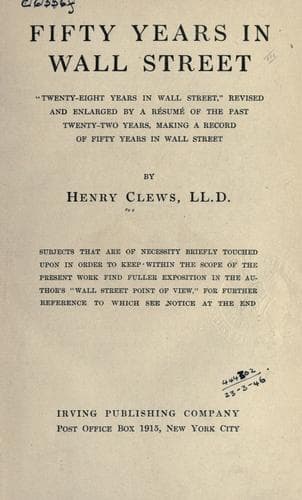
Business; Capitalists and financiers -- United States; Speculation; Wall Street (New York, N.Y.)
Napoleon then suggested the joint appeal for the six months’ armistice
to England and Russia, which was declined by both. He then made a direct
offer of mediation to the United States Government, in the most friendly
terms, and on the “high grounds of humanity.”
The United States Government did not see it in this light, and rejected
Napoleon’s humane offer.
The Confederate agents then obtained power to build ships of war in
French ports, and to arm and equip them, and proceed to sea without
molestation from the French authorities, the Treaty of Paris forbidding
such a hostile act against a friendly power like the North to the
contrary notwithstanding. The despot of France imagined himself above
all treaties at that time.
The English Alabama was then cruising in a most successful manner. The
Emperor had a conference with Mr. Arman, a large shipbuilder, and
assured him that there would be no difficulty about building the ships
for the Confederates under the disguise of their Italian destination.
Accordingly, a contract was made for building five ships of war at
Bordeaux and Nantes, and afterwards another contract for three iron-clad
rams.
In 1863 the Emperor had a great deal of business on hand, but was still
convinced, amid all his diplomatic duties that the South should be
recognized by the European powers. He was afraid, however, of putting
his Mexican expedition in jeopardy by risking a rupture with the North.
Finally, he said: “I will make a direct proposition to England for joint
recognition. This will effectually prevent Lord Palmerston from
misrepresenting my position and wishes on the American question.”
Accordingly, he had an interview with those two worthy members of
Parliament, Messrs. Roebuck and Lindsay, at Fontainebleau, which was
said to be highly satisfactory. He authorized them to state in the House
of Commons that he was both willing and anxious to recognize the
Confederate States, with the co-operation of England.
There was a great debate in Parliament on the subject, in the midst of
which Earl Russell arose and said that Baron Gros, the French Minister,
had received no communication from his Government on American affairs.
Mr. Roebuck, who made the motion on the authority of the Emperor, was
astonished that he had been so badly fooled. It still remains a mystery,
however, why Baron Gros did not receive the advice in question from the
Emperor, because M. Mocquard, the Emperor’s Secretary, wrote to Slidell
as follows: “On the next day after the interview of Messrs. Roebuck and
Lindsay with the Emperor, the Minister of Foreign Affairs telegraphed
Baron Gros to ‘officiously’ inform Lord Palmerston that, should Great
Britain be willing to recognize the South, the Emperor would be willing
to follow her in that way.”
Public-domain text, read in full here on John Shaqi.
Reviews
Reviews
No reviews yet
Be the first to share your thoughts on this work.
Elsewhere in the archive
Join the Discussion
Join the discussion
Sign in to leave a comment or review.
Sign InorCreate an account