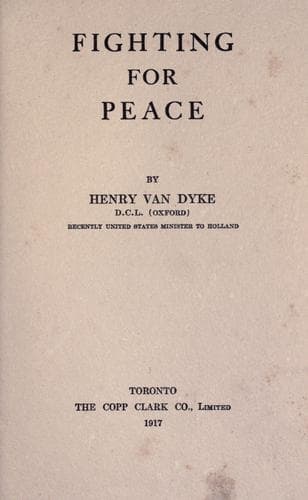
World War, 1914-1918 -- Germany; World War, 1914-1918 -- Personal narratives
I cabled to the Department of State asking permission to make the
indorsements (a thing hitherto expressly forbidden by the instructions
to diplomatic officers), and explaining that I would take in each case
the best security obtainable, whether in the form of a draft on a letter
of credit or a personal note of hand with satisfactory references, and
that no money should be drawn except for necessary living expenses and
the cost of the journey home. The answer came promptly: "You have the
authority to indorse."
So a system of international banking between two Governments was
introduced. I believe it was absolutely a new plan. But it worked.
Then another idea occurred to me. The letters of credit were usually
drawn on London or Paris. In both cities a moratorium was on. Why not
make the drafts directly on New York? Why not call on the signer of the
letter of credit for the money instead of calling on the addressee? This
would cut out any possibility of difficulty from the moratorium.
This also was a new method. But it seemed reasonable. We tried it. And
it worked. A visiting committee of New York bankers to whom I related
this experience later laughed immensely. They also made some remarks
about "amateurs" and "audacity" which I would rather not repeat. But
upon the whole they did not seem shocked beyond recovery.
So it happened, by good fortune, that there was never a day in The Hague
when an American fugitive from the war, homeward bound, could not obtain
what cash he needed for him to live and to get to the United States. But
not money to buy souvenir spoons, or old furniture and pictures. "Very
sorry," we explained, "but our Government is not dealing in antiquities
at present. It is simply helping you to get home as quickly and
comfortably as possible. Please tell us how much money you need for
board and passage-money and you shall have it."
Except three or four chronic growlers and a few passionate antiquarian
ladies, everybody took it good-humoredly and cheerfully. I think they
understood, though not always clearly, that our Government was doing
more for its citizens caught out in a tempest than any other government
in the world would have done.
When the Tennessee arrived in the latter part of August with $2,500,000
in gold for the same purpose, it was another illustration of our
Government's parental care and forethought. We received our share of
this gold at The Hague. The first use we made of part of it was to take
up the American checks and drafts on which the Bank of the Netherlands
had advanced the money. Then we sent the paper to America for collection
and repayment to the National Treasury. I have not the accounts here and
cannot speak by the book, but I think I am not far out in saying that
our loss on these transactions was less than five per cent of the total
amount handled. And we banked for some very poor people, too!
Public-domain text, read in full here on John Shaqi.
Reviews
Reviews
No reviews yet
Be the first to share your thoughts on this work.
Join the Discussion
Join the discussion
Sign in to leave a comment or review.
Sign InorCreate an account