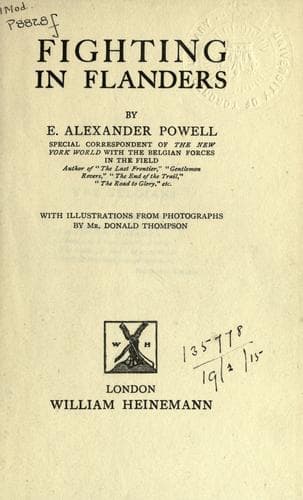
Fighting in FlandersPowell, E. Alexander (Edward Alexander)
History
Fighting in Flanders
Powell, E. Alexander (Edward Alexander)
World War, 1914-1918 -- Campaigns -- Belgium
One of the great London dailies was represented in Belgium by a
young and slender and very beautiful English girl whose name, as a
novelist and playwright, is known on both sides of the Atlantic. I
met her in the American Consulate at Ghent, where she was pleading
with Vice-Consul Van Hee to assist her in getting through the
German lines to Brussels. She had heard a rumour that Brussels
was shortly going to be burned or sacked or something of the sort,
and she wanted to be on hand for the burning and sacking. She had
arrived in Belgium wearing a London tailor's idea of what constituted
a suitable costume for a war correspondent--perhaps I should say
war correspondentess. Her luggage was a model of compactness: it
consisted of a sleeping-bag, a notebook, half a dozen pencils--and
a powder-puff. She explained that she brought the sleeping-bag
because she understood that war correspondents always slept in
the field. As most of the fields in that part of Flanders were just
then under several inches of water as a result of the autumn rains,
a folding canoe would have been more useful. She was as insistent
on being taken to see a battle as a child is on being taken to the
pantomime. Eventually her pleadings got the better of my judgment
and I took her out in the car towards Alost to see, from a safe
distance, what promised to be a small cavalry engagement. But the
Belgian cavalry unexpectedly ran into a heavy force of Germans,
and before we realized what was happening we were in a very warm
corner indeed. Bullets were kicking up little spurts of dust about us;
bullets were tang-tanging through the trees and clipping off twigs,
which fell down upon our heads; the rat-tat-tat of the German
musketry was answered by the angry snarl of the Belgian machine-guns;
in a field near by the bodies of two recently killed cuirassiers
lay sprawled grotesquely. The Belgian troopers were stretched flat
upon the ground, a veteran English correspondent was giving a
remarkable imitation of the bark on a tree, and my driver, my
photographer and I were peering cautiously from behind the corner
of a brick farmhouse. I supposed that Miss War Correspondent was
there too, but when I turned to speak to her she was gone. She was
standing beside the car, which we had left in the middle of the road
because the bullets were flying too thickly to turn it around, dabbing
at her nose with a powder-puff which she had left in the tonneau
and then critically examining the effect in a pocket-mirror.
"For the love of God!" said I, running out and dragging her back to
shelter, "don't you know that you'll be killed if you stay out here?"
"Will I?" said she, sweetly. "Well, you surely don't expect me to be
killed with my nose unpowdered, do you?"
That evening I asked her for her impressions of her first battle.
"Well," she answered, after a meditative pause, "it certainly was
very chic."
Public-domain text, read in full here on John Shaqi.
Reviews
Reviews
No reviews yet
Be the first to share your thoughts on this work.
Join the Discussion
Join the discussion
Sign in to leave a comment or review.
Sign InorCreate an account