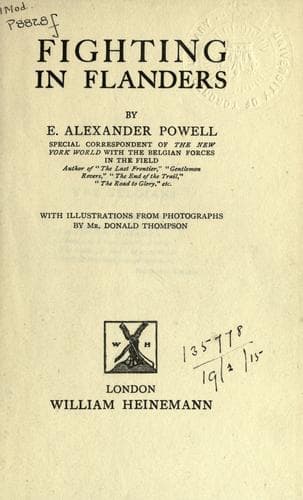
Fighting in FlandersPowell, E. Alexander (Edward Alexander)
History
Fighting in Flanders
Powell, E. Alexander (Edward Alexander)
World War, 1914-1918 -- Campaigns -- Belgium
The third and largest division of this journalistic army consisted of
free lances who went to the Continent at their own expense on the
chance of "stumbling into something." About the only thing that any
of them stumbled into was trouble. Some of them bore the most
extraordinary credentials ever carried by a correspondent; some of
them had no credentials at all. One gentleman, who was halted
while endeavouring to reach the firing line in a decrepit cab,
informed the officer before whom he was taken that he represented
the Ladies' Home Journal of Philadelphia. Another displayed a letter
from the editor of a well-known magazine saying that he "would be
pleased to consider any articles which you care to submit." A third,
upon being questioned, said naively that he represented his literary
agent. Then--I almost forgot him--there was a Methodist clergyman
from Boston who explained to the Provost-Marshal that he was
gathering material for a series of sermons on the horrors of war.
Add to this army of writers another army of photographers and
war-artists and cinematograph-operators and you will have some idea of
the problem with which the military authorities of the warring nations
were confronted. It finally got down to the question of which should
be permitted to remain in the field--the war correspondents or the
soldiers. There wasn't room for them both. It was decided to retain
the soldiers.
The general staffs of the various armies handled the war
correspondent problem in different ways. The British War Office
at first announced that under no considerations would any
correspondents be permitted in the areas where British troops were
operating, but such a howl went up from Press and public alike that
this order was modified and it was announced that a limited number
of correspondents, representing the great newspaper syndicates
and press associations, would, after fulfilling certain rigorous
requirements, be permitted to accompany his Majesty's forces in the
field. These fortunate few having been chosen after much heart-burning,
they proceeded to provide themselves with the prescribed uniforms
and field-kits, and some of them even purchased horses. After the
war had been in progress for three months they were still in
London. The French General Staff likewise announced that no
correspondents would be permitted with the armies, and when any
were caught they were unceremoniously shipped to the nearest port
between two unsympathetic gendarmes with a warning that they
would be shot if they were caught again.
Public-domain text, read in full here on John Shaqi.
Reviews
Reviews
No reviews yet
Be the first to share your thoughts on this work.
Join the Discussion
Join the discussion
Sign in to leave a comment or review.
Sign InorCreate an account