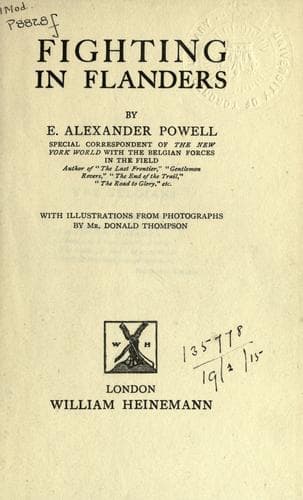
Fighting in FlandersPowell, E. Alexander (Edward Alexander)
History
Fighting in Flanders
Powell, E. Alexander (Edward Alexander)
World War, 1914-1918 -- Campaigns -- Belgium
"I'm sorry to contradict you, General," I asserted with equal
positiveness, "but I have myself seen their bodies. So has Mr.
Gibson, the secretary of the American Legation in Brussels, who
was present during the destruction of Louvain."
"Of course," replied General von Boehn, "there is always danger of
women and children being killed during street fighting if they insist
on coming into the streets. It is unfortunate, but it is war."
"But how about a woman's body I saw with the hands and feet cut
off? How about the white-haired man and his son whom I helped to
bury outside of Sempst, who had been killed merely because a
retreating Belgian soldier had shot a German soldier outside their
house? There were twenty-two bayonet wounds in the old man's
face. I counted them. How about the little girl, two years old, who
was shot while in her mother's arms by a Uhlan and whose funeral I
attended at Heyst-op-den-Berg? How about the old man near
Vilvorde who was hung by his hands from the rafters of his house
and roasted to death by a bonfire being built under him?"
The general seemed taken aback by the exactness of my
information.
"Such things are horrible if true," he said. "Of course, our soldiers,
like soldiers in all armies, sometimes get out of hand and do things
which we would never tolerate if we knew it. At Louvain, for
example, I sentenced two soldiers to twelve years' penal servitude
each for assaulting a woman."
"Apropos of Louvain," I remarked, "why did you destroy the library?"
"We regretted that as much as anyone else," was the answer. "It
caught fire from burning houses and we could not save it."
"But why did you burn Louvain at all?" I asked.
"Because the townspeople fired on our troops. We actually found
machine-guns in some of the houses. And," smashing his fist down
upon the table, "whenever civilians fire upon our troops we will teach
them a lasting lesson. If women and children insist on getting in the
way of bullets, so much the worse for the women and children."
"How do you explain the bombardment of Antwerp by Zeppelins?" I
inquired.
"Zeppelins have orders to drop their bombs only on fortifications and
soldiers," he answered.
"As a matter of fact," I remarked, "they destroyed only private
houses and innocent civilians, several of whom were women. If one
of those bombs had dropped two hundred yards nearer my hotel I
wouldn't be here to-day smoking one of your excellent cigars."
"That is a calamity which, thank God, didn't happen," he replied.
"If you feel for my safety as deeply as that, General," I said,
earnestly, "you can make quite sure of my coming to no harm by
sending no more Zeppelins."
Public-domain text, read in full here on John Shaqi.
Reviews
Reviews
No reviews yet
Be the first to share your thoughts on this work.
Join the Discussion
Join the discussion
Sign in to leave a comment or review.
Sign InorCreate an account